
The Tian Shan Mountains
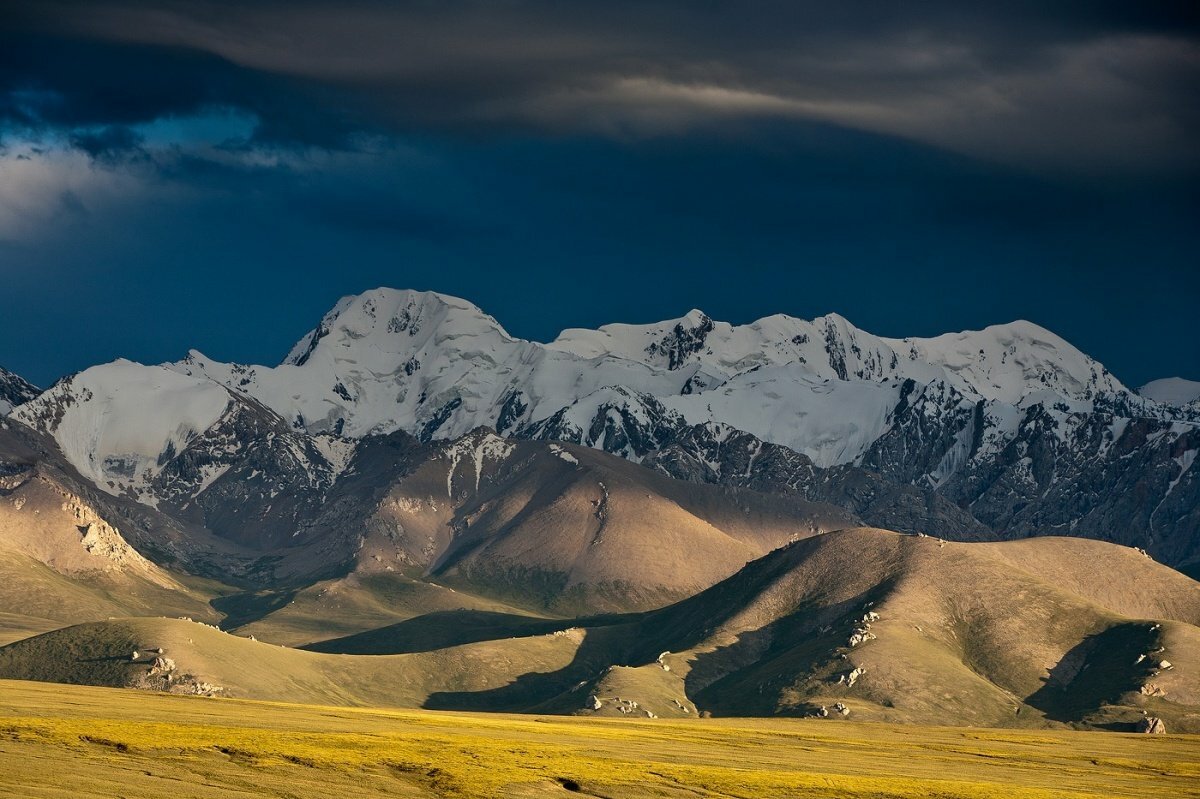
Imagine a place where snow-covered giants pierce the deep blue sky, and glaciers feed rivers that cross entire continents. This is the Tian Shan Mountains, one of the greatest mountain systems in Central Asia. For travelers tired of the well-trodden trails of the Alps or the overcrowded base camps of the Carpathians, this region becomes a true revelation. The spirit of exploration rules here, and every mountain pass tests your endurance and character. Let’s take a closer look at this remarkable land, because Tian Shan — which translates as “Heavenly Mountains” — can make you fall in love at first sight.
Where Are the Tian Shan Mountains Located?
If you look at a physical map of Eurasia, the Tian Shan Mountains immediately stand out because of their position right in the heart of the continent. They stretch across five countries, forming a natural “backbone” of the region. The main massif lies within Kyrgyzstan, Kazakhstan, and China (the Xinjiang Uyghur Autonomous Region), while its outlying ranges extend into Uzbekistan and Tajikistan. It is one of the longest mountain chains outside the Himalayas. It is worth noting that Tian Shan is sometimes confused with the Pamirs, but these are completely different systems — the Pamirs lie farther south and are famous for their seven-thousand-meter peaks.
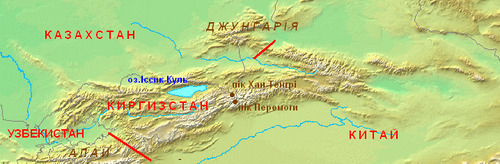
Interestingly, the Tian Shan seems to divide vast landscapes: to the south lies the Taklamakan Desert, while to the north stretch the Kazakh steppes. This geographical position creates a unique climate: the western slopes receive more moisture-bearing winds, while the eastern regions greet travelers with dryness and sharp temperature fluctuations. The distance from the Zhetysu Alatau to the Fergana Valley is impressive — about 2,500 kilometers from west to east. That is why any trek through the Tian Shan requires careful preparation: in a single day, you may pass through several climate zones.
General Description of the Mountain System
From a geological perspective, the Tian Shan is a folded mountain belt formed over hundreds of millions of years. Its terrain is extremely diverse: deep intermountain basins (such as Issyk-Kul and Naryn) alternate with sharp peaks reaching seven-kilometer elevations. About 20% of the territory is covered by glaciers — true “reservoirs” of fresh water that feed rivers such as the Syr Darya, Chu, and Ili. Because of this, the local landscapes resemble the Alps, but with a distinct Asian flavor: high-altitude deserts border juniper forests and alpine meadows. The Tuyuksu Gorge, located in the Kazakh section of the range, is an excellent example of this diversity, featuring rock walls, icy slopes, and safe acclimatization trails.


It is also worth mentioning that the system’s orography is quite complex. Scientists divide it into the Northern, Western, Central, Inner, and Eastern Tian Shan. Each of these regions has its own character: some are dominated by table-like plateaus, while others are filled with sharp pyramid-shaped peaks. For example, the Central Tian Shan is famous for its extensive glaciation, while the Eastern Tian Shan is known for rocky terrain and thin mountain air. This variety makes the Tian Shan a natural laboratory for geographers and a true challenge for mountaineers. There is even a unique phenomenon here: “flying glaciers,” which periodically break off cliffs and slide downward.
Among the region’s most striking features are several key characteristics:
- Enormous west-to-east length, creating a wide variety of climate zones.
- The presence of the deep Issyk-Kul Lake, which never freezes despite its altitude.
- Intense seismic activity — earthquakes occur frequently here, constantly reshaping the terrain.
- Relict juniper forests growing at elevations of up to 2,500 meters above sea level.
- Vast mineral reserves, particularly mercury, antimony, and coal.
This list is far from complete, but it captures the essence: the Tian Shan is a living organism that is constantly changing. Even experienced travelers who have visited the region many times discover something new on every journey. In the high mountain valleys, for example, you can come across traces of ancient glaciation or unusual weathered rock formations resembling stone mushrooms or towers.
The Most Famous Peaks
When talking about the highest points of the Tian Shan, the imagination immediately conjures snow-covered summits rivaling some Himalayan giants in height. Among mountaineers, the most famous are Jengish Chokusu (Victory Peak), Khan Tengri, and Marble Wall Peak. Each of these mountains has its own character, climbing history, and technical challenges.
Jengish Chokusu (Victory Peak)
This giant, standing at 7,439 meters, is the highest point of the entire Tian Shan mountain system. It lies on the border between Kyrgyzstan and China, in the heart of the Central Tian Shan. Victory Peak is considered one of the world’s most difficult seven-thousanders to climb due to its harsh climate, powerful winds, and technically demanding routes. The first successful ascent took place only in 1956, although attempts had been made much earlier. Interestingly, Soviet climbers concealed the mountain’s true height for a long time in order to preserve their status as its first conquerors.

For those planning a Tian Shan expedition with the goal of summiting this peak, proper acclimatization and high-altitude climbing experience are essential. Expeditions usually last from three to five weeks, with July and August considered the best climbing season.
Khan Tengri
This mountain is often called the “Lord of the Sky” — and for good reason. Its height is 6,995 meters (or 7,010 meters including the ice cap), making Khan Tengri the second-highest peak in the Tian Shan. It stands at the junction of three borders: Kazakhstan, Kyrgyzstan, and China. Its unique feature is its perfectly pyramidal shape and marble rock faces that take on a reddish hue in the sunlight. This is why it is sometimes referred to as the “Bloody Mountain” or the “Princess of the Tian Shan.”

Technically, Khan Tengri is considered even more challenging than Victory Peak because of its steep ice slopes and frequent avalanches. However, thanks to its more predictable weather conditions, it is more popular among commercial expeditions. Many climbers choose this summit to complete the “Snow Leopard” mountaineering challenge — climbing all the seven-thousanders of the former Soviet Union.
Marble Wall Peak
Unlike the previous two giants, Marble Wall Peak (around 6,400 meters) remains less known to the general public but is incredibly fascinating for professionals. It received its name from cliffs composed of marble-like limestone shimmering in white, gray, and pink shades. Located in the Central Tian Shan, it forms part of the massif adjacent to the South Inylchek Glacier. Maps show varying elevations because the summit has still not been fully explored — something that attracts pioneering climbers and lovers of untouched routes.

Ascending Marble Wall Peak requires not only physical strength but also strong navigation skills: the approaches to the base pass through an icefall zone riddled with chaotic crevasses. For this reason, expeditions to this peak are recommended only for experienced mountaineers who have already acclimatized on neighboring five-thousand-meter peaks.
Summary Table
| Peak | Height (m) | Location | Difficulty (subjective scale) |
|---|---|---|---|
| Jengish Chokusu (Victory Peak) | 7,439 | Kyrgyzstan / China | Moderate |
| Khan Tengri | 6,995 (7,010 with ice cap) | Kazakhstan / Kyrgyzstan / China | Moderate |
| Marble Wall Peak | ~6,400 | Central Tian Shan | High |
For those who only dream of mastering ice climbing techniques or taking their first steps in mountaineering, specialized programs are worth considering. For example, the Tian Shan Mountaineering School in the Tuyuksu Gorge (Kazakhstan) offers a nine-day course where experienced instructors teach participants how to use crampons, ice axes, belay systems, and rescue equipment. After such training, even beginners feel more confident on rocks and glaciers, while experienced climbers refine their skills on mixed terrain routes. And even though the first steps may seem difficult, mountain peaks reward persistence.