
Climbing Alpamayo (5947 m), Peru
We invite you to climb Alpamayo, the hallmark of the Cordillera Blanca and the entire mountain world, with the experienced team of Extreme Guide guides.
Available dates:
June 26 - July 9
Complexity:
Duration:
Height:
Alpamayo (5947 m) is one of the TOP 10 most striking peaks on the planet.
Alpamayo is the hallmark of the Cordillera Blanca and the entire mountain world. According to some surveys, it is officially recognized as the most beautiful peak on the planet. It is a perfect ice pyramid with delicate ridges and an incredibly aesthetically pleasing wall.
Climbing Alpamayo is a source of pride for any climber.
Why choose this program:
- Technical Aesthetics: You’ll climb on perfect ice, conquering steep pitches that look challenging yet logical and understandable.
- Guaranteed Acclimatization: Our program includes four days of preparation, allowing your body to gently adapt to the altitude before the summit push.
- Experienced ExtremeGuide guides and local guides are always available.
- Ultimate Comfort: At base camp, you’ll enjoy full service (tents, cook, donkeys), so you can focus solely on the climb.
Technical data for the ascent:
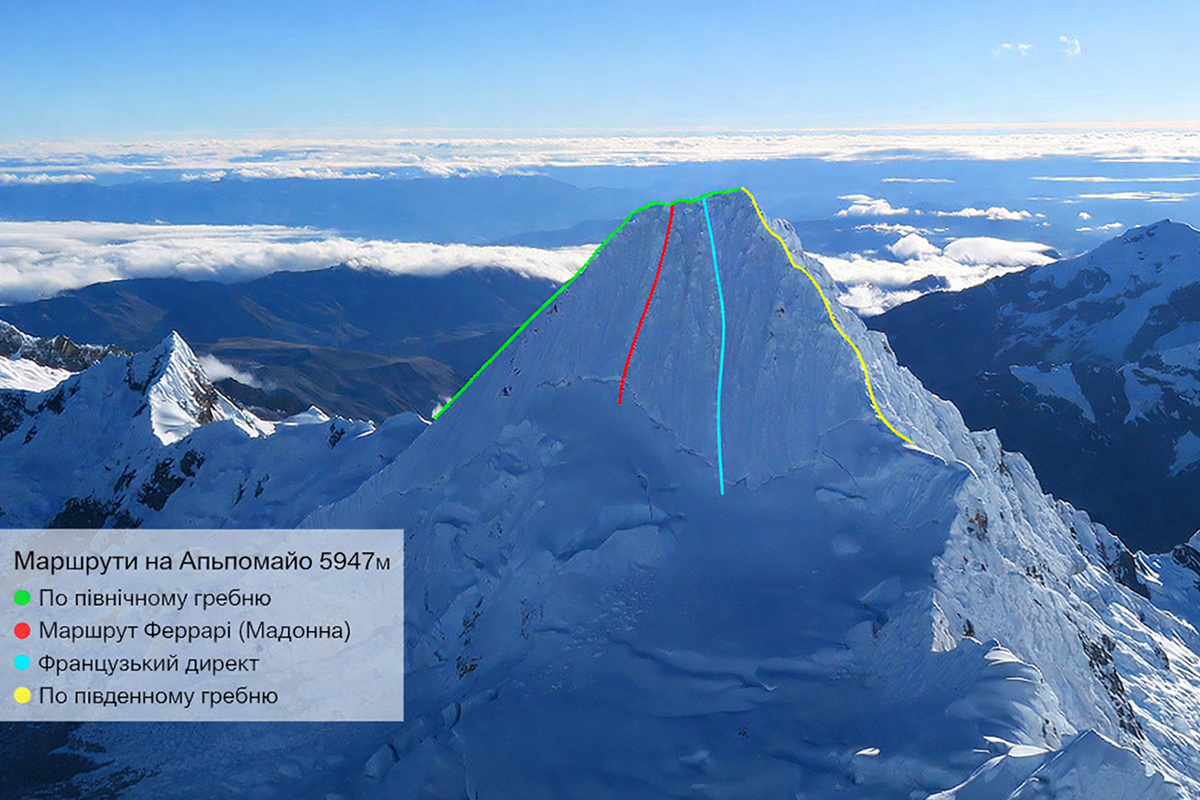
- Difficulty: Technical ice climbing (Directa Francesa route)
- Maximum angle: 65° – 80° (in areas)
- Altitude: 5,400 m (one of the most spectacular overnight stays of your life)
- Number of pitches: 8–10 pitches of pure ice
Climbing route to Alpamayo (5947 m), Peru:
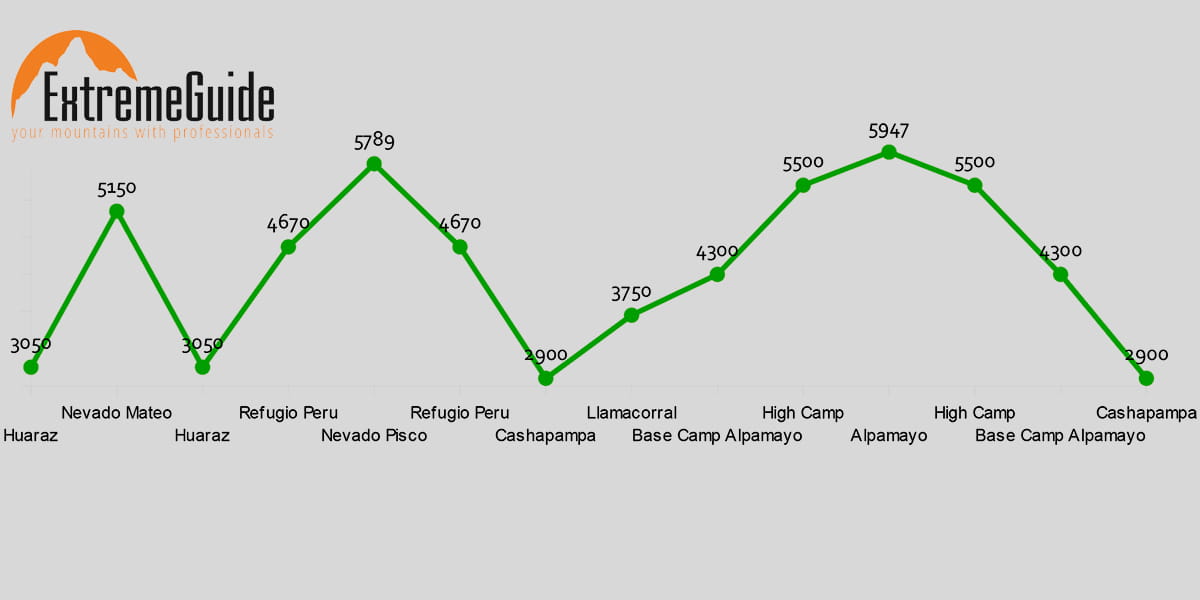
Lima – Huaraz – Laguna Villcacocha – Huaraz – Laguna 69 – Huaraz – Peak Pashpa / Pastorruri – Huaraz – Cashpampa – Llamacorral – Alpamayo Base Camp – Alpomayo High Camp – Alpamayo Summit (5947 m) – High Camp – Base Camp – Cashpampa – Huaraz – Lima
Your guides for climbing Alpamayo (5947 m), Peru
Route for climbing Alpamayo (5947 m), Peru, description of days
day
Check-in at the hotel. We’ll meet the team and take a walk along the ocean. Since Huaraz is located at an altitude of 3,000 meters, we recommend arriving in Lima a day or two early to allow time to acclimate.
day
We’ll fly here on a local airline.
Hotel accommodation. First day of adaptation.
day
An easy trek to a panoramic lake with views of the entire Cordillera Blanca. Return to Huaraz for the night.
Elevation gain: +695 m / -695 m.
Distance: 7 km.
Travel time: 3–4 hours.
day
A classic acclimatization trek. A climb to a crystal-blue lake at the foot of Chakraraha Peak. This is an important test of your readiness for altitudes of 4,500+ meters.
Elevation gain: +700 m/-700 m (start at 3,900 m).
Distance: 12 km.
Travel time: 6–7 hours.
day
A short ascent to the critical 5,000 m mark without strenuous physical exertion. The afternoon is spent checking gear and preparing food modules for the expedition.
Elevation gain: approximately +500 m.
Travel time: 4–5 hours.
day
Transfer to the village of Kashpampa, where we load our essential gear onto the donkeys. This is the start of a scenic trek through the Santa Cruz Valley. Overnight in tents.
Elevation gain: +860 m.
Travel time: 4–5 hours trekking + 3 hours transfer.
day
Trek to the foot of the mountain. Set up base camp (BC) in the kenua forest near Lake Arhuaycocha. From here, the first view of the Alpamayo pyramid opens up.
Elevation gain: +570 m.
Travel time: 5–6 hours.
day
A rest day. We conduct classes on the glacier: techniques for working with two tools, organizing stations on ice screws, checking rope connections.
day
A challenging day. Climbing moraine cliffs, reaching the glacier, and tackling a steep slope (up to 50°) to reach the saddle.
Overnight: In a tent on the ice. This is the highest and coldest point of the overnight stay.
Elevation gain: +1070 m.
Travel time: 6–8 hours.
day
Technical Part: Departure at 1:00 AM. The “Directa Francesa” route consists of 8-10 pitches of ice at an angle of 60-80°.
Descent: 6-8 rappels along the ascent to High Camp, a short break, and then a descent to a comfortable Base Camp (4,330 m).
Elevation gain: +547 m / -1,617 m.
Travel time: 10-12 hours (entire route).
day
Used in case of bad weather, strong winds, or for additional rest at the High Camp.
day
The final descent to civilization. In the evening, a celebratory dinner in Huaraz.
Elevation gain: -1,430 m.
Travel time: 7–8 hours descent + 3 hours transfer.
day
Transfer Huaraz – Lima.
day
Plan your flight at any convenient time.
Acclimatization for climbing Alpamayo (5947 m), Peru:
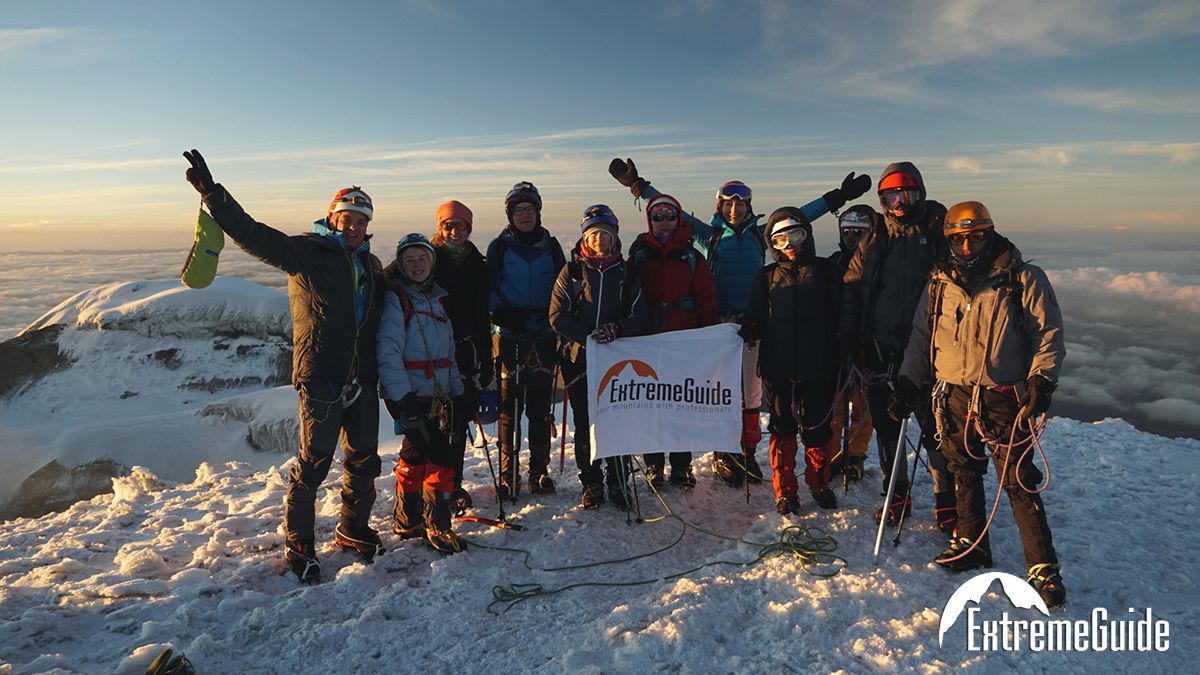
Why is it profitable to go hiking with Extremeguide?





Cost and conditions for climbing Alpamayo (5947 m), Peru
Is this trip right for you?
Who is this route for?
Despite its formidable appearance, the route is accessible to confident climbers with basic ice tool skills, good physical fitness, and experience on ice and snow routes (Mont Blanc, Monterosa). We recommend taking an ice climbing course. Under the guidance of our experienced guides, this legendary wall becomes a reality for those ready for the challenge.
Included in the price:
- Guide services: 1 ExtremeGuide guide works with the entire group throughout the program; 1 guide per two participants during the ascent (we use local guides);
- Flight to Lima – Huaraz and back;
- Transfers during acclimatization;
- Transfer Huaraz – Cashapampa (national park entrance) – Huaraz;
- National Park entry permit;
- Mules for carrying equipment to and from Base Camp;
- Accommodation at the Huaraz Hotel (4 nights);
Shared equipment (ice screws, ropes, snow anchors, quickdraws, slings); - Shared equipment rental (canteen, dishes, gas);
- Tents in camps (occupancy per 2 people);
- Chef on the trek – full board meals;
- Gas, food, shared dishes;
- Group first aid kit;
- Radios for guides (walkie-talkie).
The price does not include:
- Accommodation in Lima;
- Meals in towns and villages;
- Climbing insurance;
- Various drinks;
- Personal equipment rental;
- All expenses related to early termination of the program;
- Optional excursions;
- Personal porter;
- Tips for the guide and staff.
Price depending on the number of participants
| Number of participants | Cost per 1 participant |
|---|---|
| 4 | 4900 USD |
| 3 | 5200 USD |
| 2 | 6700 USD |
| 1 | 12000 USD |

Best price guarantee!
- We have included in the price all possible basic expenses for the program and guarantee that there are no hidden additional costs, while we have retained the best service at a low price: transfers, hotel accommodation, guides and staff!
We have a flexible discount system
Find out the details right now:
Necessary equipment
Basics:
- Transport duffel bag/backpack not less than 100 l. We will not wear them;
- Assault backpack 45-50 l (More about choosing a backpack);
- Sleeping bag up to – 15 C (More about choosing a sleeping bag);
- A pad for sleeping (preferably a thick and warm) (More about choosing a rug).
Clothing and footwear:
Special clothing for climbing and heights above 5000m:
- High-altitude boots for climbers above 6000 m with the possibility of fixing semi-automatic crampons;
- Wind- and moisture-proof jacket and pants (Gore-Tex or other waterproof);
- Thick (warm) and medium-thick socks;
- A set of thermal underwear (trousers and a long sleeve shirt);
- The second layer is a fleece jacket or softshell;
- Softshell pants for mountaineering;
- Thin gloves – preferably fleece with a windstopper membrane;
- Warm gloves;
- A cap/protective face mask that can be worn under a helmet;
- A down or synthetic jacket with similar thermal properties.
Clothes and shoes for trekking:
- Light trekking boots or high trekking sneakers;
- 2-3 pairs of thin socks;
- Light pants;
- T-shirt with a long sleeve (longsleeve)/T-shirt;
- A buff, cap or hat with wide brims;
- Changeable underwear.
Rest:
- Hermo packing for things/(large polyethylene bags for packing things);
- Personal lightweight dishware (cup, spoon, bowl);
- Personal hygiene products;
- Headlamp + set of batteries;
- Documents in airtight packaging;
- Individual a first-aid kit (plaster, cold, stomach, head. You also need to take into account specific and chronic diseases, if they are present. In addition to an individual first-aid kit, the guide has a general first-aid kit);
- Climbing goggles (protection category 3-4);
- Mountain ski mask (in case of wind and precipitation on the mountain);
- Lipbalm;
- Sunscreen ointment;
- Water container (1 l);
- Thermos (1 l);
- Gloves are thin;
- Rescue blanket (emergency blanket).
Special equipment:
- Mountaineering belay system;
- 3 locking carabiners;
- Belay/descender device with dual-rope descent and locking carabiner;
- 1.5m, 6mm diameter rappel cord;
- Double-lanyard with locking carabiners;
- Crampons for technical climbing with anti-slip devices;
- 2 ice tools for technical climbing;
- Helmet.
- Trekking poles;
- Seating pad.
Additional Information
Climbing Alpamayo is a challenging undertaking that requires some mountaineering experience and good physical fitness. On the Alpine scale, the route is rated AD+, roughly equivalent to UIAA grades III–IV.
- Residents of most countries do not require a visa to visit Peru (for stays of less than 90 days).
- Emergency and medical insurance (insurance with coverage of at least $30,000 and coverage for mountaineering risks).
The group meets in Lima.
KLM, Air France, Lufthansa, Iberia, Air Europa, and their partner airlines, such as LATAM (connected with LAN Peru and Avianca) and others (e.g., Turkish Airlines, Swiss Air)
Before long treks of 6-8 hours during the acclimatization period, before significant temperature fluctuations (daytime temperatures of +30°C, nighttime temperatures of -5°C to -15°C at the summit) during the day, before walking along rocky trails and glaciers. Before a certain degree of discomfort at altitudes above 4,500 m.
In the cities, we stay in comfortable 4* hotels; in the mountains, we live in tents. At the high-altitude camp, conditions are derivative, with no showers or electricity.
Meals are served in cafes in towns and prepared by a chef along the route, and are included in the price. We recommend bringing additional energy bars, nuts, and other snacks during the ascent.
It’s convenient to take a wheeled suitcase or a duffel bag with handles with a capacity of 100 liters or more, as well as a 45-50 liter backpack for storing a sleeping bag, mat, and climbing gear. The backpack weighs approximately 10 kg. We use mules on this trek, so the ascent will be as light as possible.
Guides will have a first aid kit for emergency medical care. However, it is recommended to bring personal medications for chronic and specific illnesses, bandages, headache tablets, cold and pain relievers, and vitamin C and B vitamins for better adaptation to the mountains.
A doctor and medical oxygen are available at the base camp.
Throughout the entire route—from the trek to base camp to the summit push—traditional mobile phone coverage is unavailable. Communication is only possible via satellite phones or specialized satellite trackers.
The average temperature is up to +26°C, with daytime temperatures in the mountains reaching +10°C to +15°C, and along the coast, +30°C.
At the Alpamayo (5,947 m) altitude, extreme conditions prevail: at the summit camp, nighttime temperatures typically drop to -10°C to -15°C, while at the summit itself, due to strong winds, temperatures can reach -20°C and below.
This route takes place at altitudes above 5,000-6,000 meters, where solar radiation is much stronger than on the plains. The mountain climate and thin air affect the body’s condition for the first 5-7 days. Improper acclimatization and rapid elevation gain can lead to altitude sickness.
That’s why we’ve developed a special acclimatization program and health monitoring for each participant along the route. The trek isn’t technically challenging and follows a mountain road, but it does require good physical fitness and adherence to mountain safety regulations. All guide instructions along the route are mandatory!
We recommend reading the article about acclimatization in the mountains.
Peculiarities of acclimatization in high mountains
Also watch a video about altitude sickness.
Also read the article on preparation: Physical and mental preparation before climbing and hiking in the mountains
And watch a series of videos about the training process.
Absence of diseases incompatible with active tourism: List of diseases
- Technical qualifications: Experience in ice or combined routes rated AD-AD+ (3A-3B according to the CIS classification).
- Altitude adaptation: Experience in climbing or trekking at altitudes of 4,000 meters or higher.
- Special skills: confidently negotiate ice slopes with inclinations ranging from 45° to 55°.
- Physical fitness: In addition to technical skills, a high level of endurance is required for 6-7 hour hikes with vertical gains of up to 1,200 meters.
At least two weeks before arriving in the mountains, you should stop training or switch to a very gentle regimen to allow your body time to recover. Before the ascent.
The official currency of Peru is the Peruvian Nuevo Sol (PEN).
The best rates are offered at currency exchange offices (Casas de Cambio) in city centers. Avoid exchanging at airports due to the low rates.
In large cities (Lima), Visa and Mastercard are accepted almost everywhere. For cash withdrawals, use ATMs from major banks such as BCP, Scotiabank, or Interbank. Always choose to pay in local currency (PEN) to avoid unnecessary currency conversion fees.
The table shows the basic cost for a group and may change depending on the number of people in the group. For the calculation of the cost of the tour for a smaller number of people and individual groups, see the «Price» block for more details.
We guarantee that on the dates indicated in the table, even if there is a minimum number of people allowed in the group, the tour will take place 100% with a minimum change in cost.
Pleasant bonuses, which everyone receives when ordering a tour with us


Photo of previous trips
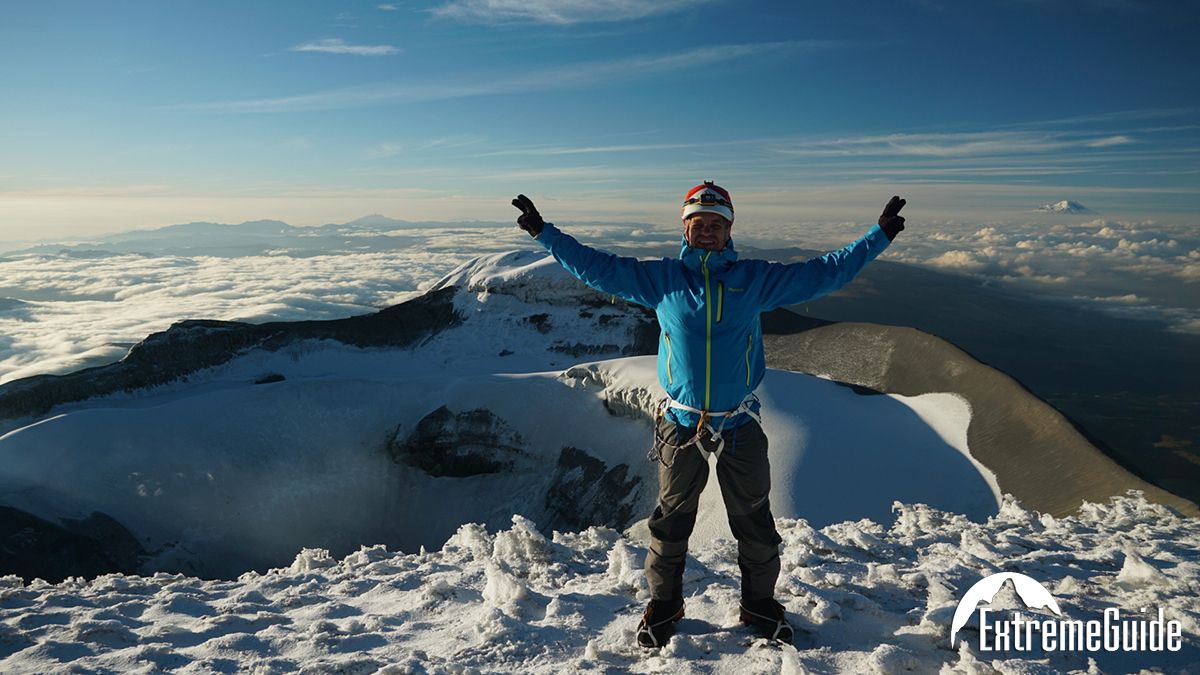
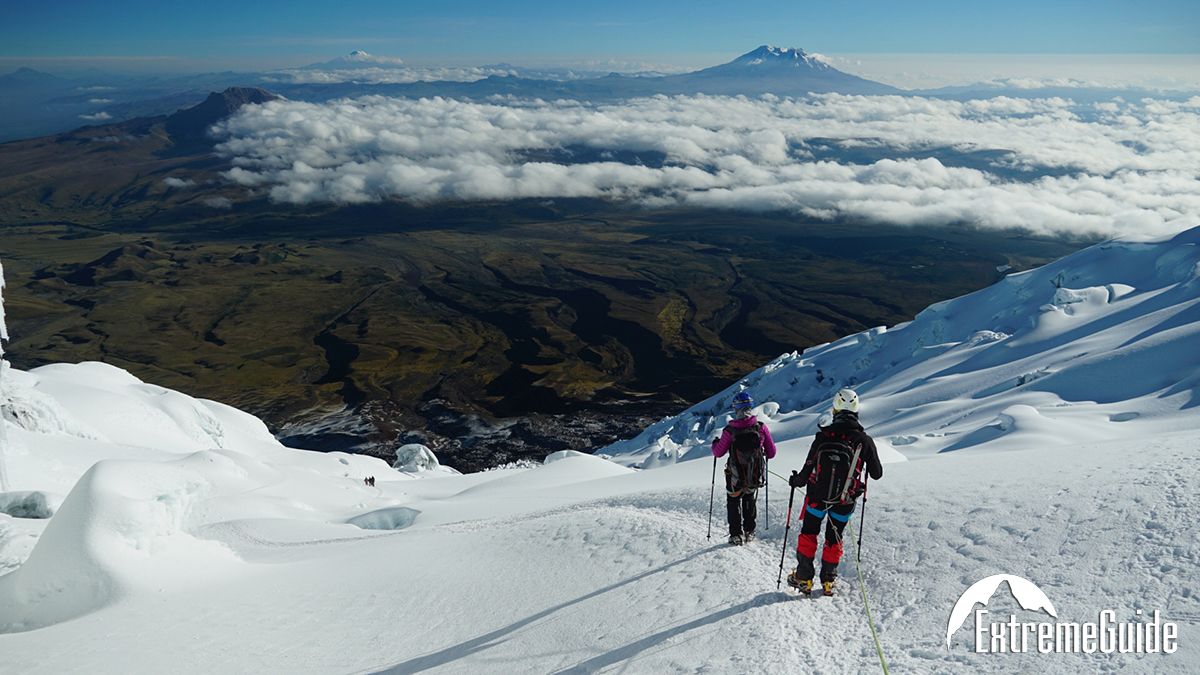
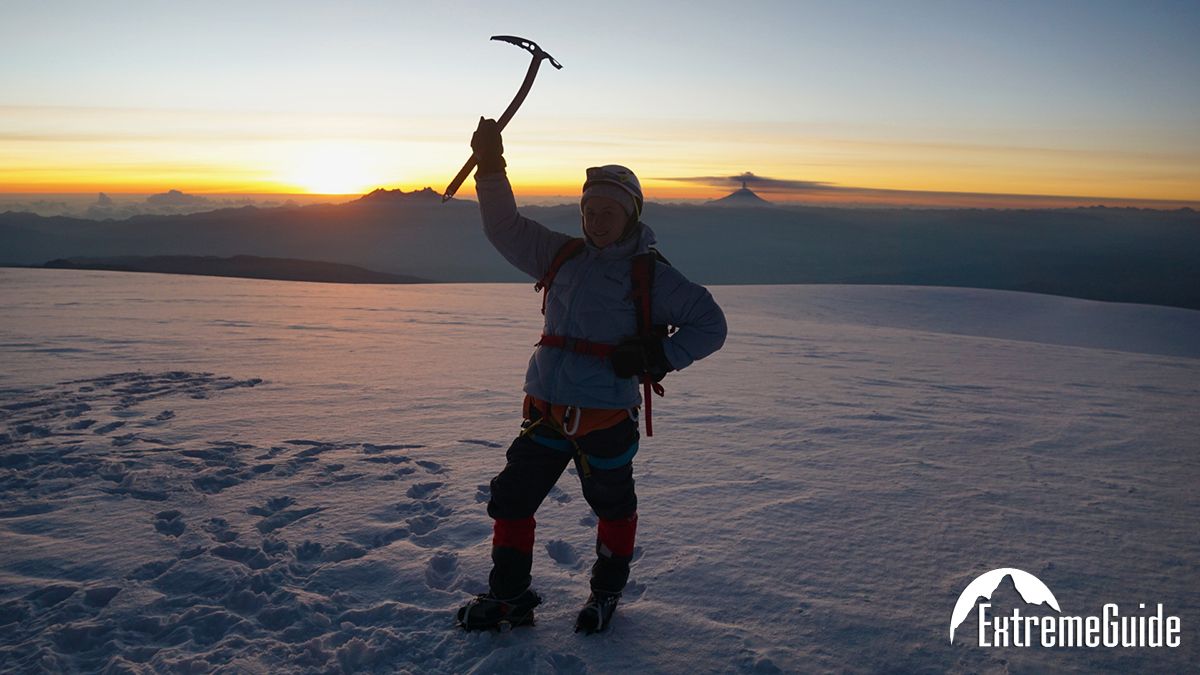
Reviews of our travelers
Recommended tours
 Alps
Alps
Dates:
July 3 - July 7
July 17 - July 21
August 14 - August 18
August 28 - September 1
September 11 - September 15
Complexity:
Duration:
Height:

Left: 2 places
 Slovakia (Tatras)
 Dates:
December 5 - December 6
February 5 - February 6
March 5 - March 6
Complexity:
Duration:
Height:

5.0 (4)
Left: 4 places
 Bolivia
 Dates:
August 29 - September 7
August 29 - September 10
Complexity:
Duration:
Height:
Left: 8 places
 Himalayas
 Dates:
April 17 - May 4
Complexity:
Duration:
Height:

5.0 (90)
Left: 6 places
 Mexico
 Dates:
November 26 - December 5
November 26 - December 12
March 6 - March 15
March 6 - March 22
Complexity:
Duration:
Height:
Left: 5 places
 Kyrgyzstan
 Dates:
July 4 - July 25
Complexity:
Duration:
Height:
Left: 6 places
 Alps
Alps Dates:
Complexity:
Duration:
Height:
 Himalayas
 Dates:
Complexity:
Duration:
Height:
 Argentina
 Dates:
Complexity:
Duration:
Height:
 Pamir
Pamir Dates:
Complexity:
Duration:
Height:
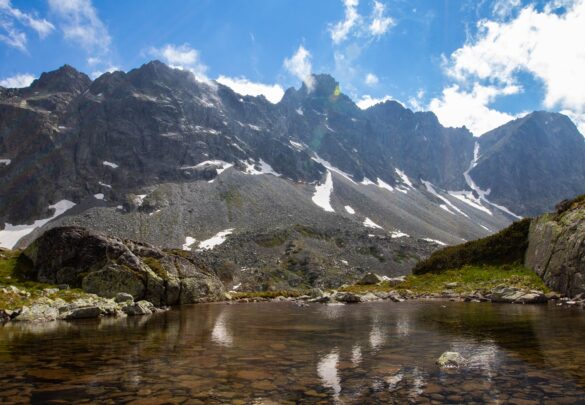 Slovakia (Tatras)
 Dates:
Complexity:
Duration:
Height:
 Kyrgyzstan
 Dates:
Complexity:
Duration:
Height: