
Classification of routes and difficulty categories in mountaineering
Before we start talking about such a complex and multifaceted topic as the difficulty of climbing routes, let’s answer one very important question: why does a climber actually need to know and be able to navigate the classification of routes and categories of difficulty?
The first and most important reason is the desire to go to the mountains without accidents! And for this, the main principle that you need to be guided by when choosing a route is its feasibility for you and your group. Then we can talk about the safety of its passage.
Emergence of difficulty categories in mountaineering
In 1894, Austrian mountaineer Friedrich Benesch proposed one of the world’s first systems for classifying the difficulty of mountaineering routes. His scale included seven levels, with the easiest routes designated by the number VII and the most difficult at that time designated by the number I. Over time, more difficult categories were added to the scale, which were designated 0 and later 00.
Wilhelm Welzenbach and the scale he proposed designated the highest numbers for the most difficult and high-altitude ascents. This later became the basis for the creation of the six-step Alpine scale, developed in 1947 in Chamonix. Over time, it received international recognition and was renamed the UIAA scale in 1968.
In the 1930s, members of the Sierra Club in North America adapted the Welzenbach scale to rate the difficulty of routes in the Sierra Nevada region. This system eventually evolved into the Yosemite Decimal System (YDS), which soon became widely used throughout North and South America.
Over time, different regions of the world began to develop their own difficulty rating systems. Most of them were focused on classifying routes for pure climbing. However, there are also scales designed to evaluate technical climbing or the use of artificial support points (AIP).
The system of difficulty categories in the former CIS countries
The system of uniform difficulty categories in the Post-Soviet space allows you and your teachers to understand what experience you already have and what you are ready for, even if the peaks you have been to are one in Kamchatka and the other in the Caucasus, and you yourself and your teacher are in Kazakhstan in the Tuyuk-Su gorge.
In addition, the classification of routes is the basis for the system of sports categories in mountaineering. The qualification level of each climber is determined by the available experience of climbing routes of a certain category of complexity and the amount of knowledge acquired during preparation for them, while fulfilling the requirements of a single training program.
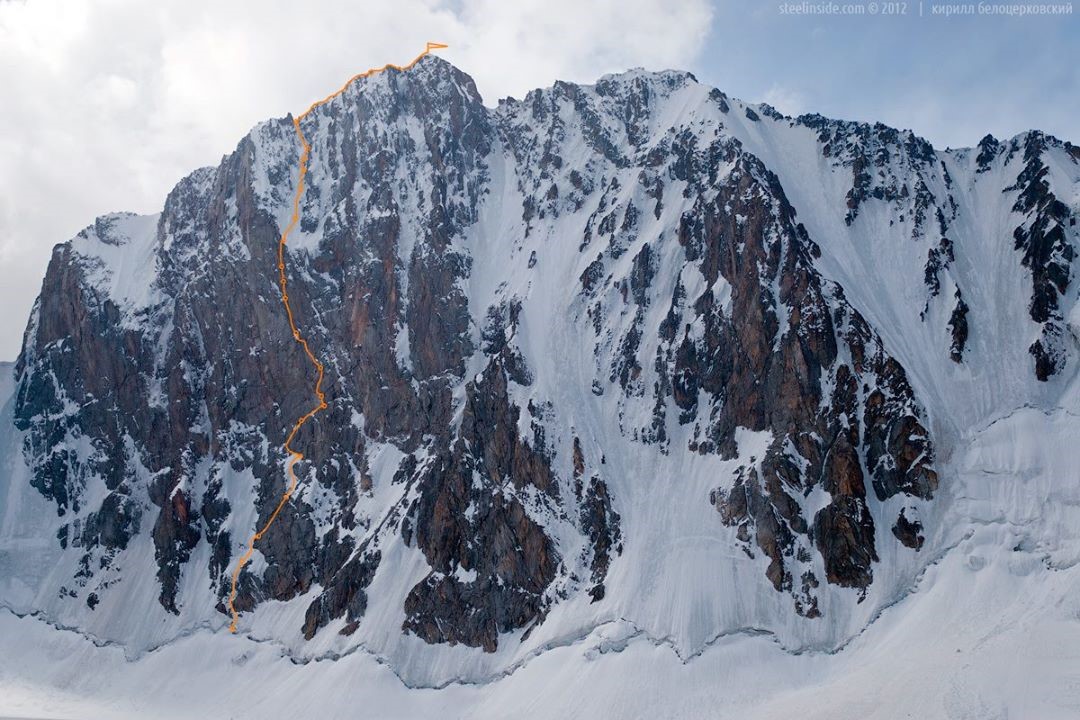
The classification of mountain peaks in the USSR began in the pre-war years and has been constantly expanded and systematized since then. After the collapse of the USSR, it remained virtually unchanged and is now in effect throughout almost the entire territory of the post-Soviet space.
The route classification aims to give a general assessment of the route taken to the summit.
The difficulty category is assigned to a route by a specific commission of the Mountaineering Federation of the former CIS countries after the submission of a report on its passage by the pioneers.
This assessment is subjective, but there are several factors that are usually used:
- The difficulty of individual sections, their length and location on the route;
- The absolute height of the summit, which simultaneously characterizes the change in the category of areas depending on the absolute height of their location;
- The actual length of the route (excluding approaches and descent, regardless of their length and difficulty, along moraines, glaciers, screes, etc.);
- Average steepness of the route;
- The time required to complete the route, allocated to groups prepared for a given difficulty category.
Based on these parameters, there are 6 categories and 6 semi-categories in each category. Below is a very brief description of them:
Null (IA) — very easy category: Can be overcome without using any special equipment.
First (I) — easy category: Basic mountaineering training and skills in working with equipment are required for passing.
Second (II) — Easy category: Passed by climbing and descending using hands to create support. Passing requires mountaineering training.
The third (III) — medium category: Climbing these sections requires special training and is done by free climbing, using your hands, with a backpack.
Fourth (IV) — above average category: steep rock sections with a limited number of holds, requiring intense free climbing and good mastery of the technique of moving on mountain terrain. Passing with a backpack is possible, but very difficult.
Fifth (V) — difficult category: steep rocks of varied relief with a very limited number of inconvenient holds, stops, ledges, having, however, a sufficient number of cracks to create artificial supports for passage, good physical, technical and tactical training is required. The movement is carried out by free climbing only alternately, with the possible use of artificial support points.
Sixth (VI) — very difficult category: extremely difficult smooth vertical and overhanging rocks with a very limited number of inconvenient holds, ledges, ledges, even cracks that allow for artificial support points and belay. Requires advanced mountaineering training.
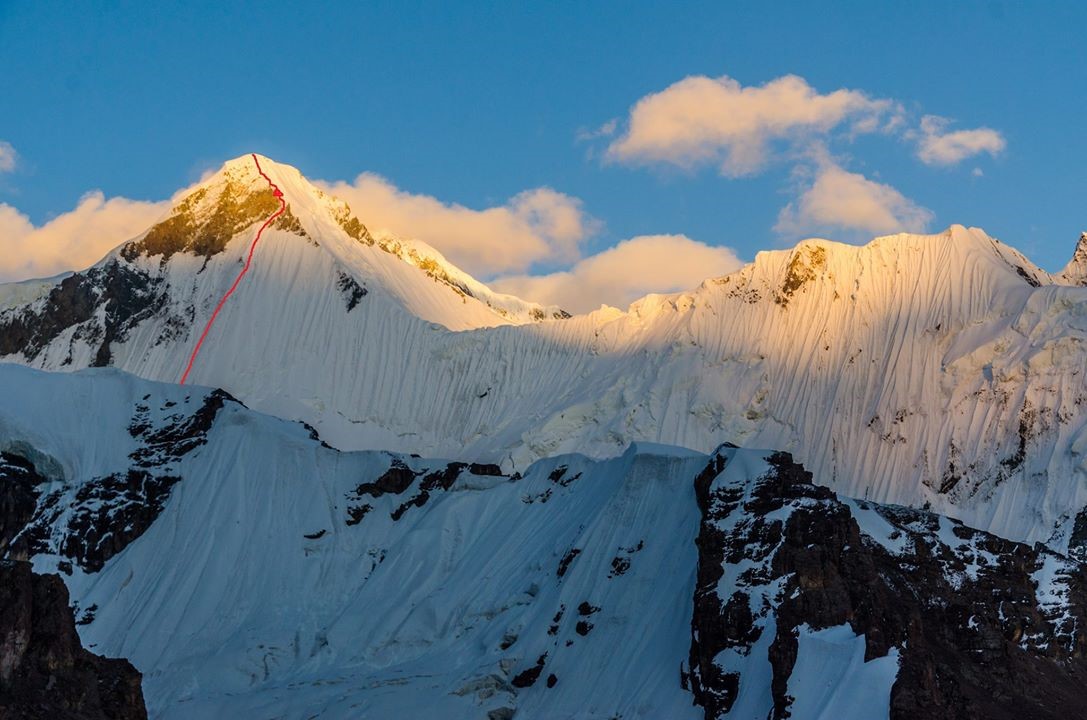
In addition, by the type of relief, mountaineering routes are divided into rock, snow-ice and combined. Class standards require experience in rock and combined climbing. There are few purely ice-snow routes in the classification, and by the experience gained on them, they are actually equated to combined ones. The classification of a route as rock or combined is made by the predominant nature of difficult places, determining the category of difficulty.
Along with ascents to peaks, traverses are also classified – passing at least two peaks, and the descent from the previous peak must take place in the direction of the next one and not along the ascent route. Both ascents and traverses can be classified differently for summer and winter climbings. The following categories of routes are accepted for the classification and titles in mountaineering: 1B, 2A, 2B, 3A, 3B, 4A, 4B, 5A, 5B, 6A, 6B.
By the way, route qualifications and difficulty categories in other countries may differ from the system used in the former CIS countries, so when you arrive in another area, make sure you understand what is being discussed and choose the route correctly.

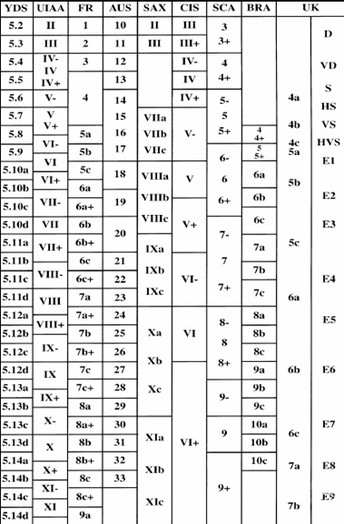
Summary table of difficulty categories:
Mountaineering
The difficulty scale of mountaineering routes takes into account the overall difficulty of the ascent, including not only the difficulty of the climb, but also such factors as the height of the summit, the length of the route, and its technical difficulty. All of these aspects affect the final assessment. Although different countries have their own local scales for assessing the difficulty of mountaineering routes, the two most widely used in the world remain the Alpine (European) and Russian (Soviet).
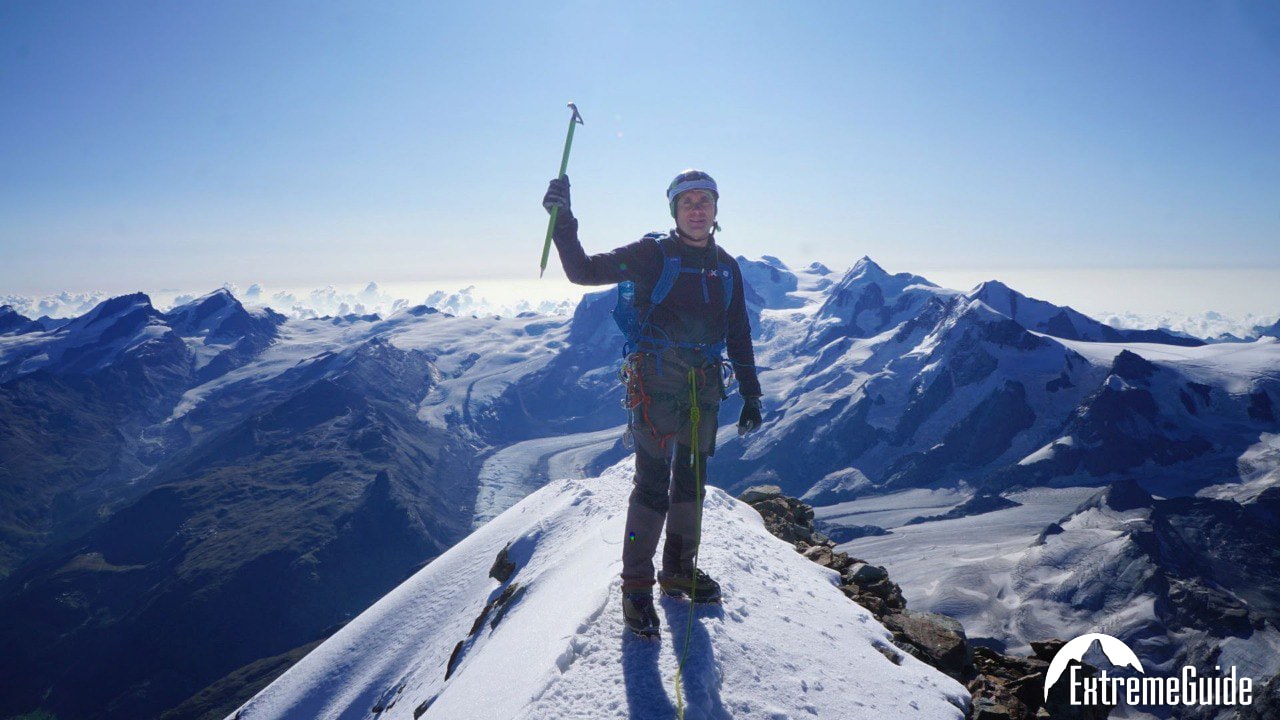
Alpine scale:
F (Facile/Easily) — Very simple rocks and/or snow slopes, crossing areas of mountain glaciers without significant cracks.
PD (Peu Difficile/Slightly more difficult) — The route may include short sections of more difficult climbing, as well as overcoming more complex mountain glaciers.
AD (Assez Difficile/Quite difficult) — Climbing steep rocks and overcoming ice slopes with a steepness of up to 50°.
D (Difficile/Difficult) — Long-term difficult climbing on rock, ice and snow terrain.
TD (Tres Difficile/Very difficult) — Complex remote routes of great length with a lot of difficult climbing on various mountain terrain, often with overnight stays on the route.
ED (Extrement Difficile/Extremely difficult) — Extremely high level of technical difficulties, very remote complex and long routes, usually requiring one or more overnight stays along the route.
It is worth emphasizing that the key difference of the Russian system is that it takes into account the altitude of the peak when assessing the overall difficulty of the route. This means that relatively simple routes to peaks of 6,000–7,000 meters can have the same difficulty category as extremely difficult routes to lower peaks.
Soviet (Russian) scale:
1А — The terrain is a little more challenging than just walking uphill on rough terrain.
1B — The route includes simple, short rock sections that may require basic rock climbing skills, as well as gentle ice sections.
2А — On such routes there are more extended sections of simple rocks and hollow ice; to pass you need to know how to use safety equipment.
2B — In addition to long simple rock sections and hollow ice, you can encounter short rock walls with a slope of up to 3 and ice sections with a steepness of up to 50°.
3А — Routes in this category may include short sections of rock 4.
3B — On such routes the number and length of 4th category rock sections increases significantly.
4А — The difficulty of the rocks on such routes rarely drops below 2, and the key sections can have a difficulty of 5a-5c. Ice areas become longer with a steepness of up to 50°.
4B — The climbing difficulty is the same as on 4A routes, but the routes themselves are much longer.
5А— The difficulty of the rocks on such routes rarely falls below 3, and the key sections can have a difficulty of 6a-6b. The ice areas are long and steep up to 70°.
5B — The difficulty of the rocks on such routes is mainly 3-4, the key sections are long with a climbing difficulty of 6a and higher, and the use of aid may also be required. The ice areas are long and steep up to 80°. Often such routes require at least one overnight stay.
6А — Serious routes to big mountains. Typically the ascent takes several days. The routes are full of difficult climbing on complex terrain. Rocks, ice, a mix of great steepness and high difficulty over a large distance of the route.
6B — Since the Russian system does not have the ability to increase the difficulty categories upwards, all routes that are significantly more difficult and serious than 6A routes are classified.
Rock climbing
Among the most popular scales used in rock climbing are the already mentioned French, North American and UIAA. These systems of route difficulty assessment have gained wide recognition and are used in various regions of the world.
UIAA The scale is designated by Roman numerals from I to XII, where I corresponds to the simplest level. For a more precise gradation of complexity, additional signs “-” and “+” are used. For example, the level can be represented as V-, a little more difficult – V, and even more difficult – V+. After that comes VI-, VI and VI+, and so on.
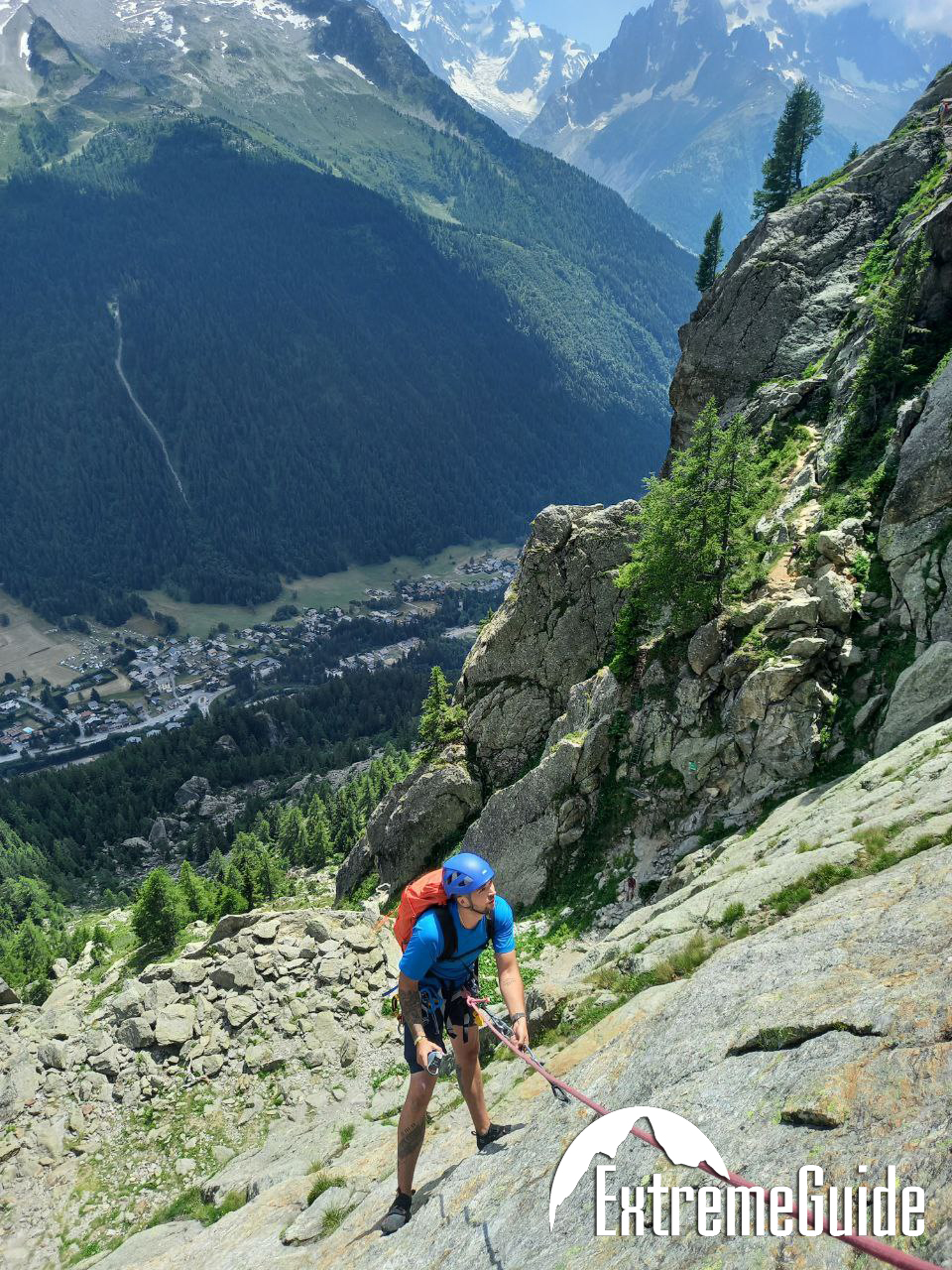
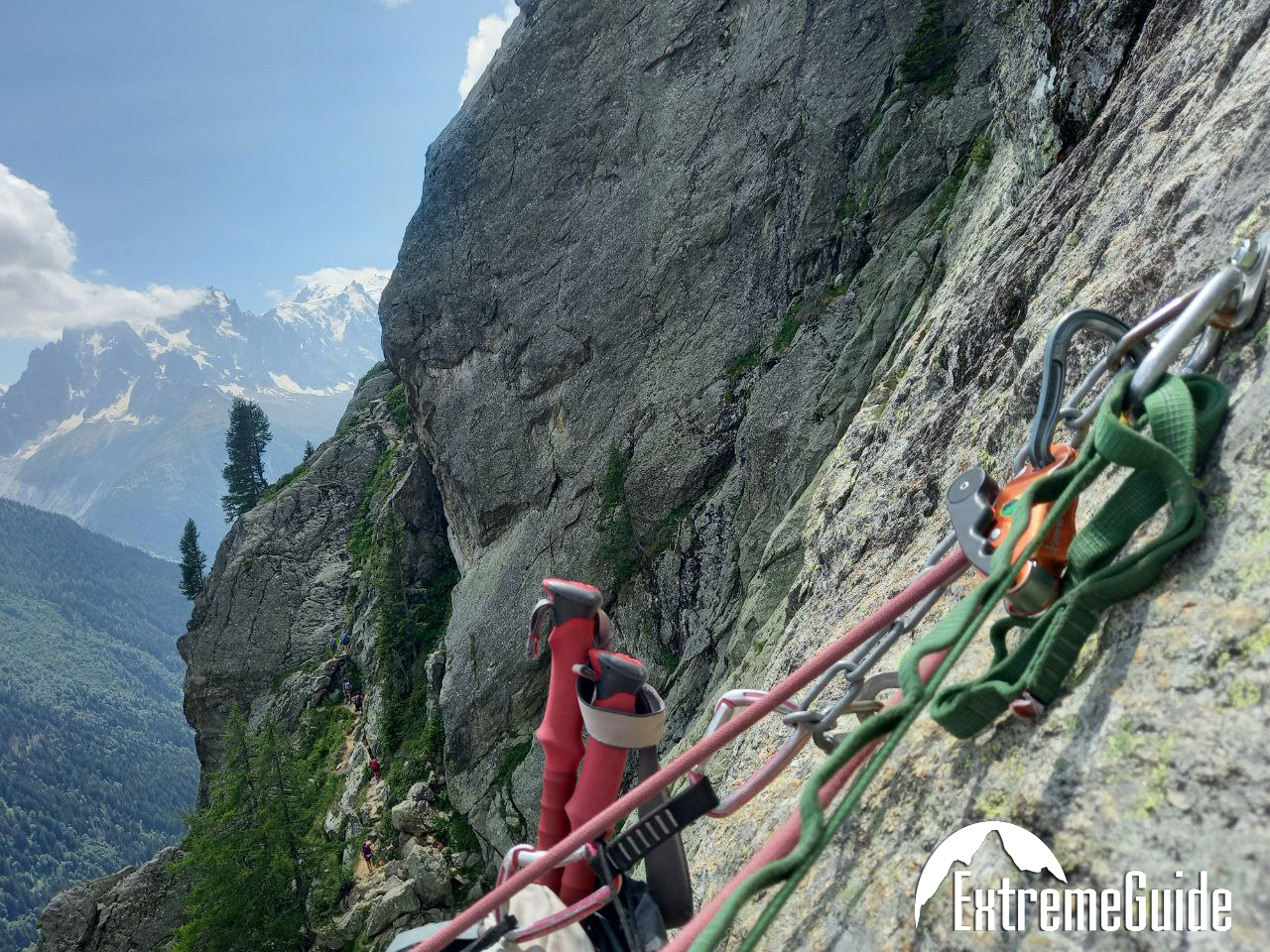
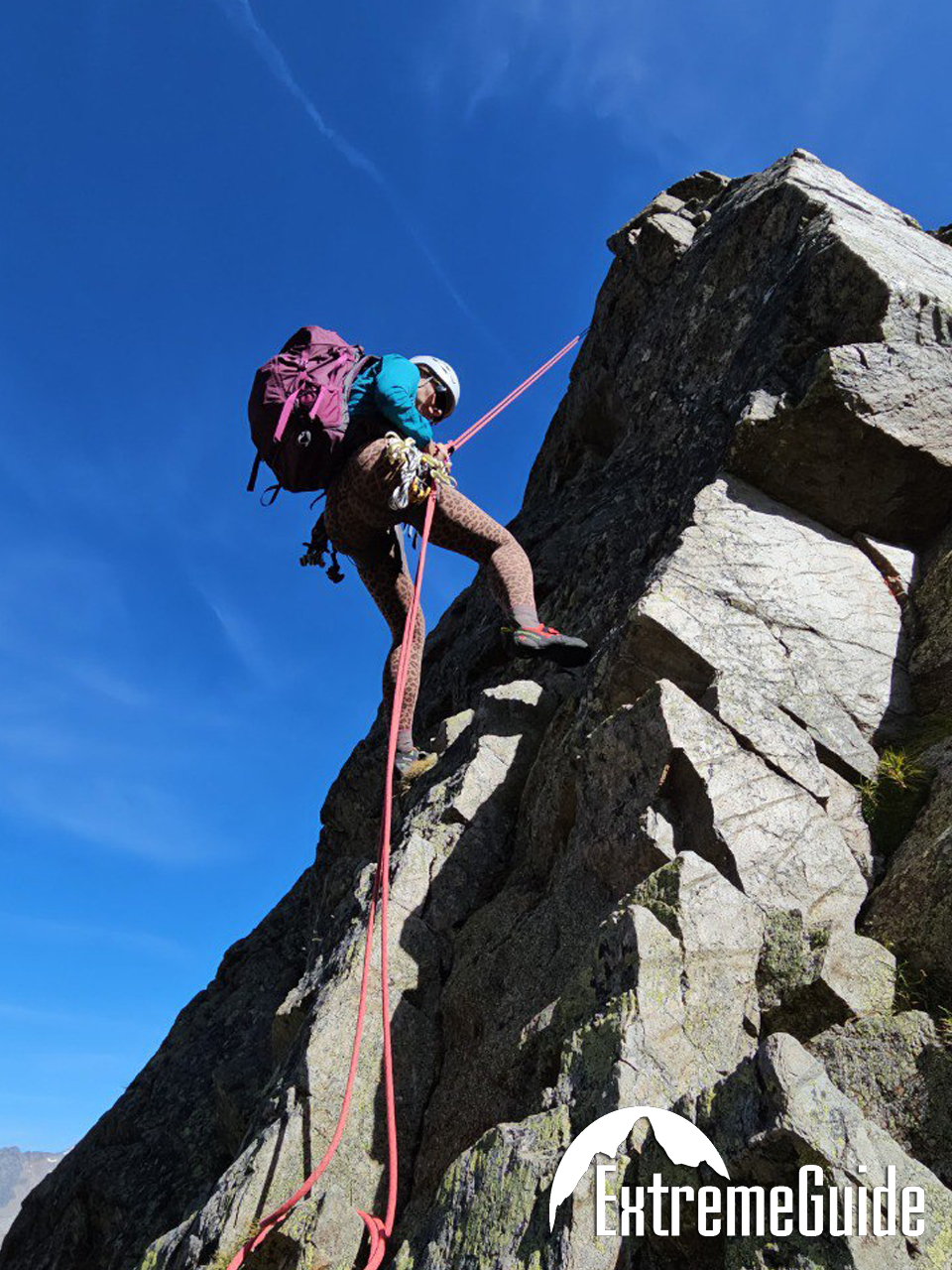
The French scale is considered one of the most common in the world. It was developed in the bouldering area of Fontainebleau, near Paris. There is also a separate French scale designed specifically for bouldering. It is designated by Arabic numerals from 1 to 9, where 9 is the highest level, and a more precise gradation starting from the 5th category is given using the letters a, b and c. Also, when moving from one level to another, the sign “+” is added. For example, 6a – 6a+ – 6b – 6b+ – 6c – 6c+ – 7a – 7a+ – 7b – 7b+ etc.
The North American Yosemite Decimal System (YDS) may seem complicated at first glance, but it is actually quite logical and simple. It is based on a decimal fraction, where the whole number denotes the classes. Let me remind you that this scale was originally created to assess the difficulty of hiking and climbing.
1 – Walking on level ground and/or equipped trails.
2 – Walking/hiking on inclines, climbing, sometimes requiring use of hands.
3 – Steeper climbing with constant use of hands, where short falls are possible, but overall fairly flat.
4 – Steeper than in previous classes, serious falls and falls are already possible, and the use of a rope for protection is recommended.
5 – Climbing on rocks where hands and feet are constantly involved, using technical equipment and ropes for safety, since any fall can be fatal.
The real level of rock climbing starts with the 5th grade. For a more detailed gradation of difficulty, a fractional part is used, and starting from the level 5.10, the letters a, b, c and d are added. The sequence of increasing difficulty looks like this, for example: 5.9 – 5.10a – 5.10b – 5.10c – 5.10d – 5.11a – 5.11b – 5.11c – 5.11d, and so on, up to the maximum level of 5.15d.
Ice climbing
In ice climbing, it is important to distinguish between several types of surfaces:
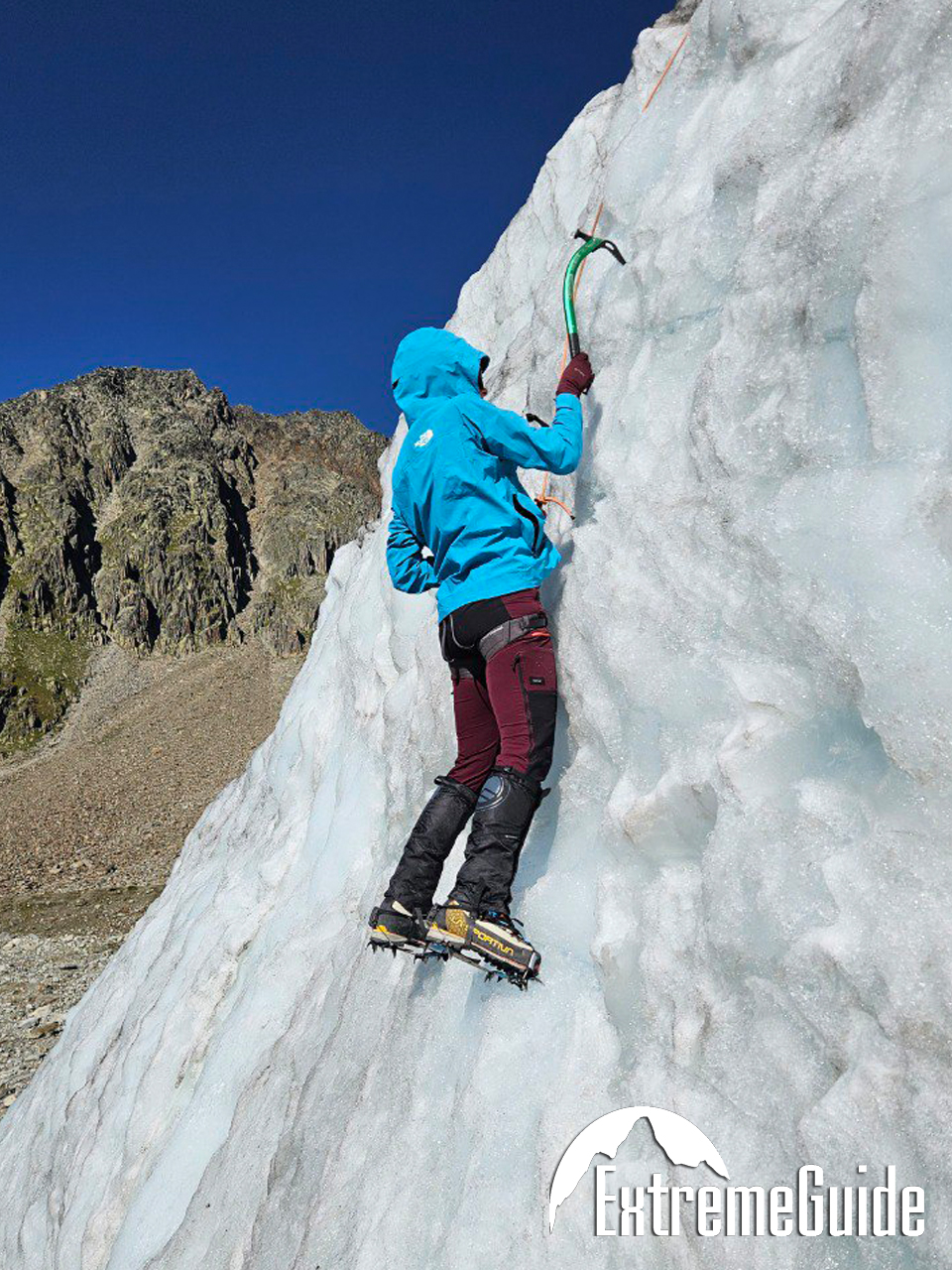
- Glacier or alpine ice is ice that forms and accumulates in mountains as large glaciers over many years.х лет.
- Cascade ice (frozen waterfalls) is seasonal ice that forms in winter, most often in the lower parts of valleys.
- Mixed climbing is a combination of climbing on different types of surfaces, including ice, rock, snow, or a combination of these.
To complete the picture, we can also add dry tooling, which involves climbing using ice tools exclusively on rocks, without snow or ice.
The difficulty of climbing on glacier ice is determined by the steepness of the ice surface: the steeper the slope, the higher the level of difficulty. The scale used for evaluation is designated as AI (from the English Alpine Ice). After the letter designation, an Arabic numeral is indicated, corresponding to the degree of difficulty:
AI 1 – Ice up 50°
AI 2 – Ice up 60°
AI 3 – Ice up 70°
AI 4 – Ice up 80°
AI 5 – Ice up 90°
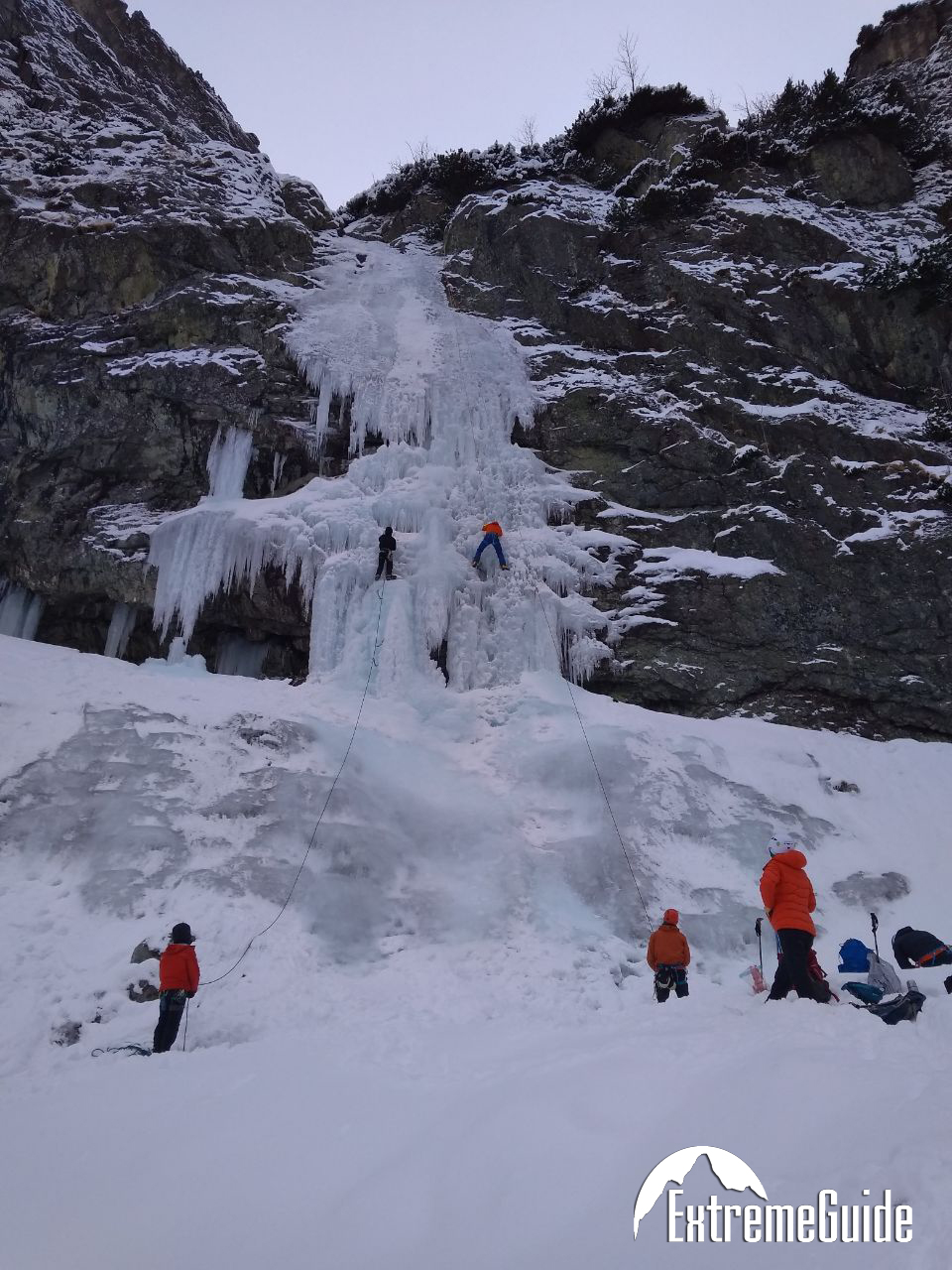
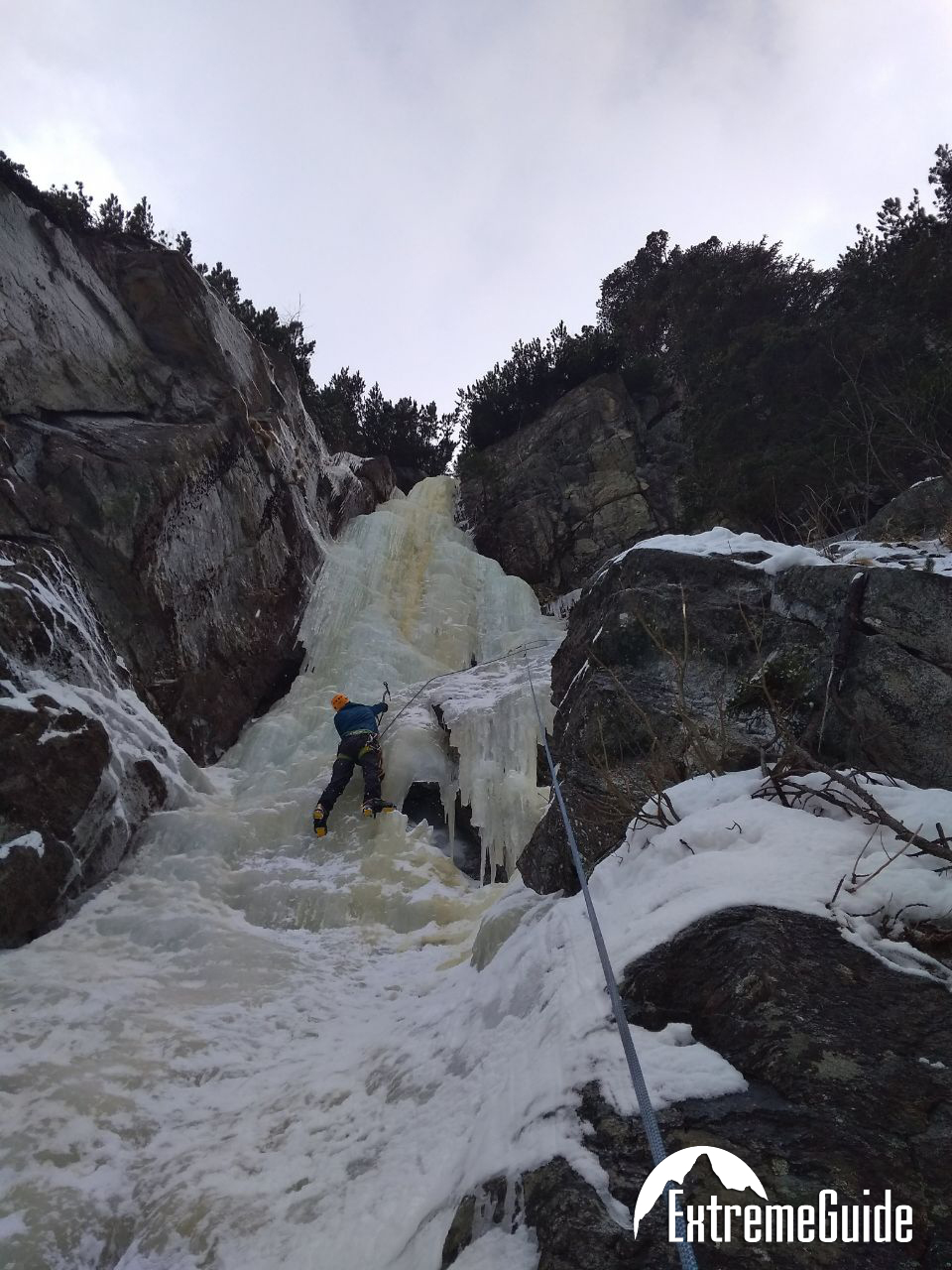
Climbing on cascade ice has its own peculiarities. In addition to steepness, the quality and reliability of the ice plays an important role, which affects not only the physical difficulty, but also the potential risk of falling. The WI scale (from the English Waterfall Ice) is used for evaluation, where an Arabic numeral follows the letter designation. In some cases, a “+” sign is added if the actual difficulty of the climb is between two categories.
WI 1 – Reliable ice up to 50°
WI 2 – Reliable ice up to 60°
WI 3 – Reliable ice up to 70° with short areas 80°-90°
WI 4 – Mostly reliable ice up to 80° with short sections of 90°, but there are areas of fragile unreliable ice
WI 5 – The slope is 85°-90°, there are long sections of fragile, unreliable ice
WI 6 – Mostly fragile, unreliable ice with a steepness of 90°, overhanging areas may occur
WI 7 – Poor quality, unreliable ice 90° and above, lots of overhangs and/or climbing on thin icicles
The mixed climbing scale is designated by the letter M (from mixt) and an Arabic numeral, where the easiest route has a category of M1, and the most difficult today is M15. The rating of mixed routes resembles the rating systems for rock climbing. Here, the quality of the insurance and the rocks do not play a decisive role – only the difficulty of the climbing itself is taken into account. However, ice tools are used to move along the route, and instead of rock slippers, boots with crampons are used.
ITO
The rating of climbing using artificial support points, or ITO (short for aided climbing in English), deserves special attention. The climber uses belay points that he himself installs on the terrain to move along the route. A simple example of aid climbing is using quickdraws to reach the next hold. More complex forms of aid climbing involve installing special devices such as a sky hook, a steel hook that hooks onto small protrusions on the rock. A rope ladder is attached to the sky hook, which the climber uses to ascend higher. After this, it is necessary to find a suitable place to install the next belay point or support.
Unlike the climbing difficulty scale, the ITO scale classifies the severity of the consequences of a fall on such sections. That is, the ITO level will depend on the quality and reliability of the belay points and the possible depth of the fall in the event of a fall. There is a classic scale and a North American scale (or as it is called – the “new wave scale”).
Classic scale:
A0 – Sections are marked with reliable pitons.
A1 – Areas where reliable intermediate insurance can be easily arranged.
A2 – Areas where reliable intermediate belay can be organized, but it is not always easy to set up points, and the transition from one point to another is not convenient. Falls are possible, but only to a small depth.
A3 – Sections with a series of unreliable points in a row, which are interrupted by reliable belay points. Deep falls are possible, but without serious consequences.
A4 – Sections with unreliable points in a row, withstanding only the weight of the body, but not a jerk. Danger of deep unpredictable falls, high probability of injury.
A5 – The sections are passable almost entirely at points that can only withstand body weight, but not a jerk. The danger of unpredictable falls to a depth of 20 meters or more, a very high risk of injury.
New Wave Scale:
A1 – Areas where reliable intermediate insurance can be easily arranged.
A2 – Areas where reliable intermediate belay can be organized, but it is not always easy to set up points, and the transition from one point to another is not convenient. Falls are possible, but only to a small depth.
A2+ – Areas with a series of unreliable points in a row that are difficult to place. Possible failures to a depth of up to 10 m.
A3 – Areas with a series of unreliable points in a row that are difficult to place. Possible failures to a depth of up to 15 m.
A3+ – Sections with a series of unreliable points in a row, which are difficult to place, some of them can only withstand body weight, but not a jerk. Falls to a depth of up to 15 m are possible.
A4 – Sections with unreliable points in a row, withstanding only body weight, but not a jerk. Danger of falling to a depth of up to 30 m. High risk of injury.
A4+ – Long sections with unreliable points in a row, withstanding only body weight, but not a jerk. Danger of falling to a depth of up to 30 m. Very high risk of injury.
A5 – It is impossible to place a single point between the belay stations that can withstand a fall.
A6 – Neither the belay station nor the intermediate points are capable of withstanding a fall.
Happy climbing and safe descent everyone!!!
Popular tours with Extreme Guide!
 Slovakia (Tatras)
Dates:
March 21 – March 22
Complexity:
Duration:
Height:

5.0 (2)
Left: 3 places
 Tajikistan (Fan Mountains)
 Dates:
July 12 – July 21
July 12 – July 24
July 25 – August 3
July 25 – August 6
August 8 – August 17
August 8 – August 20
Complexity:
Duration:
Height:

5.0 (15)
Left: 5 places
 Nepal (Himalayas)
 Dates:
October 25 – November 11
Complexity:
Duration:
Height:

Left: 6 places
 Mexico
 Dates:
March 14 – March 23
March 14 – March 30
Complexity:
Duration:
Height:

4.9 (27)
Left: 8 places
 Kyrgyzstan
 Dates:
July 11 – July 23
Complexity:
Duration:
Height:
Left: 3 places
 Kyrgyzstan
 Dates:
July 18 – August 8
Complexity:
Duration:
Height:
5.0 (15)
Left: 6 places
 Turkey
 Dates:
May 2 – May 9
September 28 – October 5
Complexity:
Duration:
Height:
Left: 4 places
 Argentina
 Dates:
January 24 – February 16
Complexity:
Duration:
Height:
Left: 8 places
 Africa
 Dates:
March 25 – April 4
August 10 – August 20
September 19 – September 29
November 11 – November 21
December 24 – January 3
January 3 – January 13
January 31 – February 10
February 28 – March 10
Complexity:
Duration:
Height:

5.0 (1)
Left: 8 places
 Georgia
 Dates:
June 27 – July 8
July 11 – July 22
July 25 – August 5
August 8 – August 19
August 22 – September 2
September 5 – September 16
Complexity:
Duration:
Height:

5.0 (1)
Left: 4 places
 Ecuador
 Dates:
December 27 – January 7
December 27 – January 11
January 31 – February 11
January 31 – February 15
Complexity:
Duration:
Height:

5.0 (82)
Left: 8 places
 Chile
Chile Dates:
January 9 – January 22
January 24 – February 6
Complexity:
Duration:
Height:
Left: 8 places