
The compass — the driving force of travel
Imagine a traveler setting out into unexplored lands without a single point of reference. In the past, people relied on signs, stars, and their own intuition. However, the real breakthrough that turned chaotic wandering into purposeful travel was the invention of the compass. Since then, this small device has remained a timeless symbol of courage, exploration, and confidence on any journey. No mountain hiking is complete without it, because it is the compass that provides a sense of safety where trails disappear among the rocks.
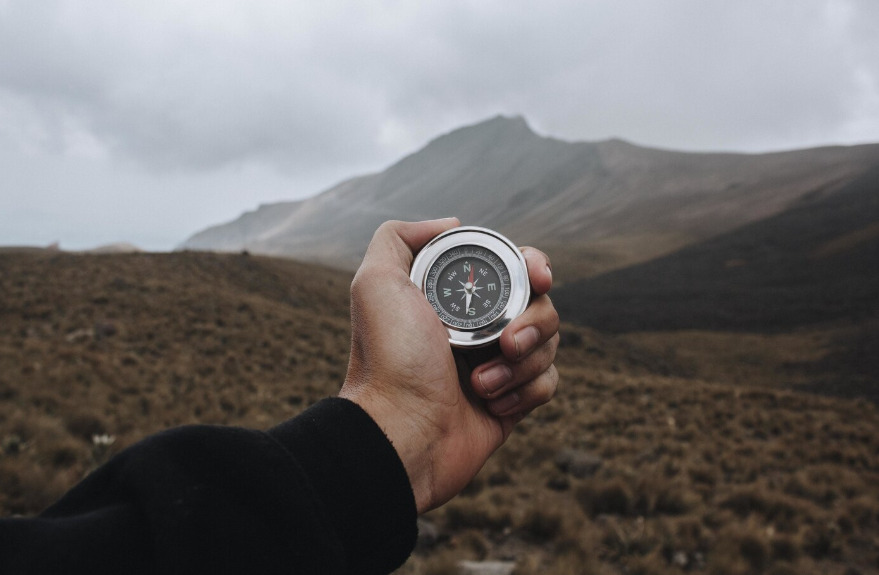
In the era of digital technology and satellite navigation, a needle that always points north may seem almost archaic. Yet experienced travelers know: batteries run out, gadgets break, but the Earth’s magnetic field works forever. A compass does not lie, does not require updates, and is not afraid of bad weather. It is the reliable companion that will not fail even in the thickest fog or the densest forest. Let’s explore what lies behind this familiar dial and how this tool has been saving lives for centuries.
What is a compass and how does it work?
Simply put, a compass is a device used to determine cardinal directions. Its core is a magnetized needle that rotates freely. One end of this needle always points toward the geographic North, and the other toward the South. This phenomenon is called magnetism: our planet has its own magnetic field, which causes the needle to align along its field lines. Therefore, when you hold the device in your hand, it automatically shows where north, south, west, and east are.
However, it is not as simple as it seems at first glance. There is a difference between magnetic north and geographic north — this is called magnetic declination. The deviation varies in different parts of the world. For a simple walk in the park, it can be ignored, but in a difficult mountain expedition it requires precise route adjustment. Modern models often include a special screw for making corrections so that you always follow the true course. Without understanding these nuances, even the most expensive device becomes just a decorative toy.
History of invention
The invention of the compass was not a single moment of inspiration, but a long chain of discoveries across different civilizations. The earliest mentions of a magnetic navigation device date back to China during the Han Dynasty (around the 2nd century BCE). At that time, it was not quite like the modern compass: a magnetized piece of ore — magnetite — was placed on a smooth wooden plate or floated in a bowl of water. This “spoon compass” indicated direction but was mainly used for divination rather than navigation. Only later did Chinese sailors realize its practical value during voyages far from shore.
In the 12th century, the technology reached Europe. Arabs, who traded with China, passed the knowledge to Italians and Spaniards. Europeans quickly improved the design: the magnetized needle was mounted on a pivot at the center of a circular case — the compass card. This allowed it to function even on a rolling ship. The Italian city of Amalfi even claims authorship of the modern compass design. Gradually, the device acquired more of the features we recognize today: degree markings, a protective casing, and later, liquid inside the chamber to dampen needle movement. Thus, a simple piece of ore became one of the driving forces of the Age of Exploration.
Types of compasses
The modern market offers many variations of this navigation tool. Each type is designed for specific tasks: from sports orienteering to military use.
All compasses fall into two main categories: magnetic and electronic. The differences lie not so much in the operating principle as in form, construction, and application.
Liquid-filled magnetic compass
The liquid-filled magnetic compass is the most common and versatile option for tourists. Its main feature is a sealed capsule filled with liquid that stabilizes the needle and reduces its oscillation. This ensures accurate readings even while moving, which is especially important during hiking or trekking.
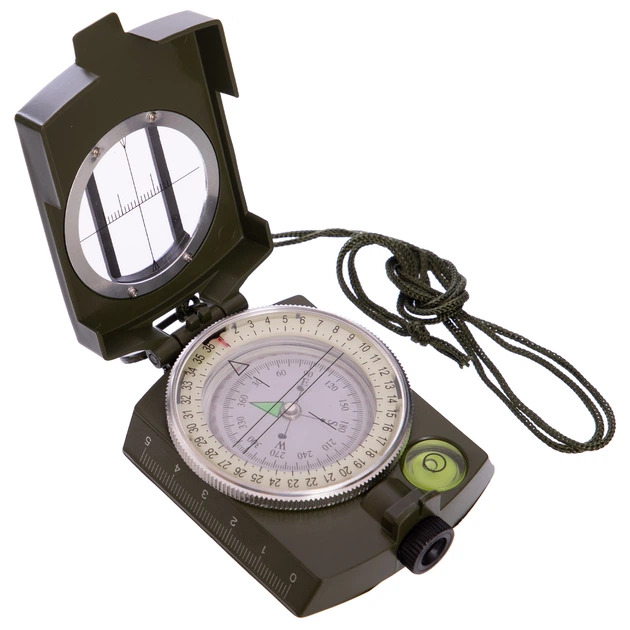
Such a compass requires no power supply, is easy to use, and highly reliable. It is ideal for basic navigation in mountains, forests, and unfamiliar terrain. That is why it is most often chosen as a first compass for travel.
Baseplate compass
The baseplate compass is designed for map work. Its transparent base allows it to be placed directly on a map, while additional features such as rulers and scales make route planning and bearing measurement much easier.
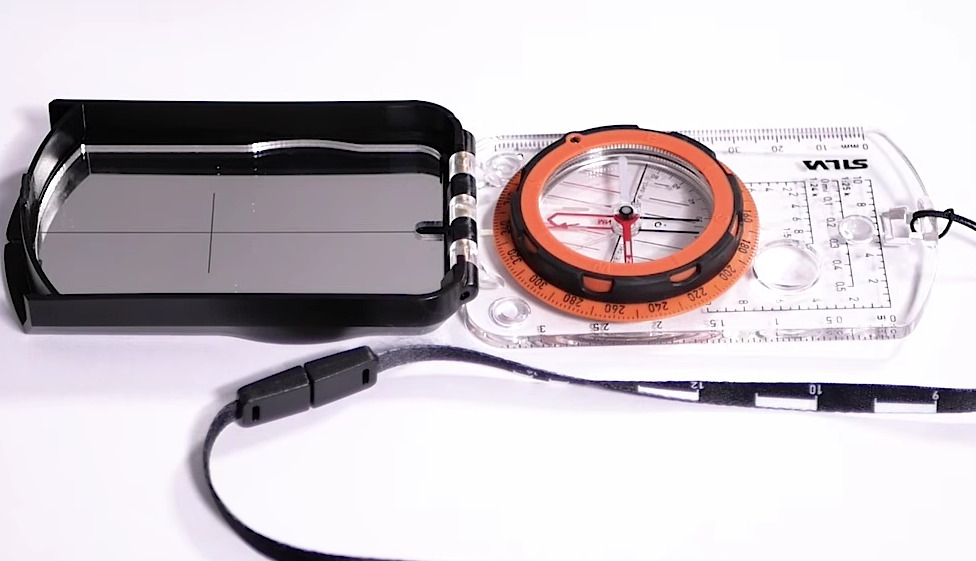
This type is widely used in sports orienteering and among experienced travelers. It allows precise alignment of movement direction with the map, which is especially useful on complex routes where maximum accuracy is required.
Lensatic (military) compass
The lensatic compass is characterized by high accuracy and a durable design. Its body is usually made of metal, and a special sighting mechanism (a visor) allows precise targeting of distant objects. These models often use a different angular measurement system used in the military.
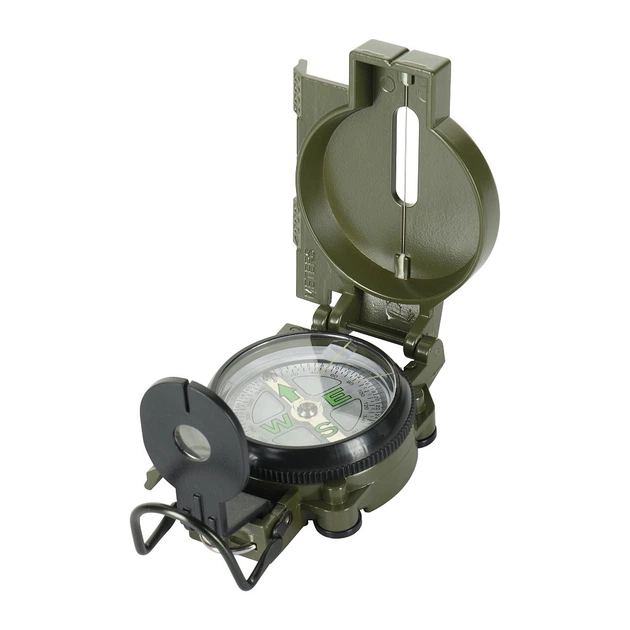
Thanks to its reliability, this compass is suitable for extreme conditions, survival situations, and difficult routes. It is less convenient for map work than a baseplate compass, but indispensable where maximum precision and durability are required.
Geological (clinometer) compass
The geological compass is a specialized instrument that combines a standard compass with a clinometer. It measures not only direction but also slope angles, which is essential for studying rock formations and terrain.
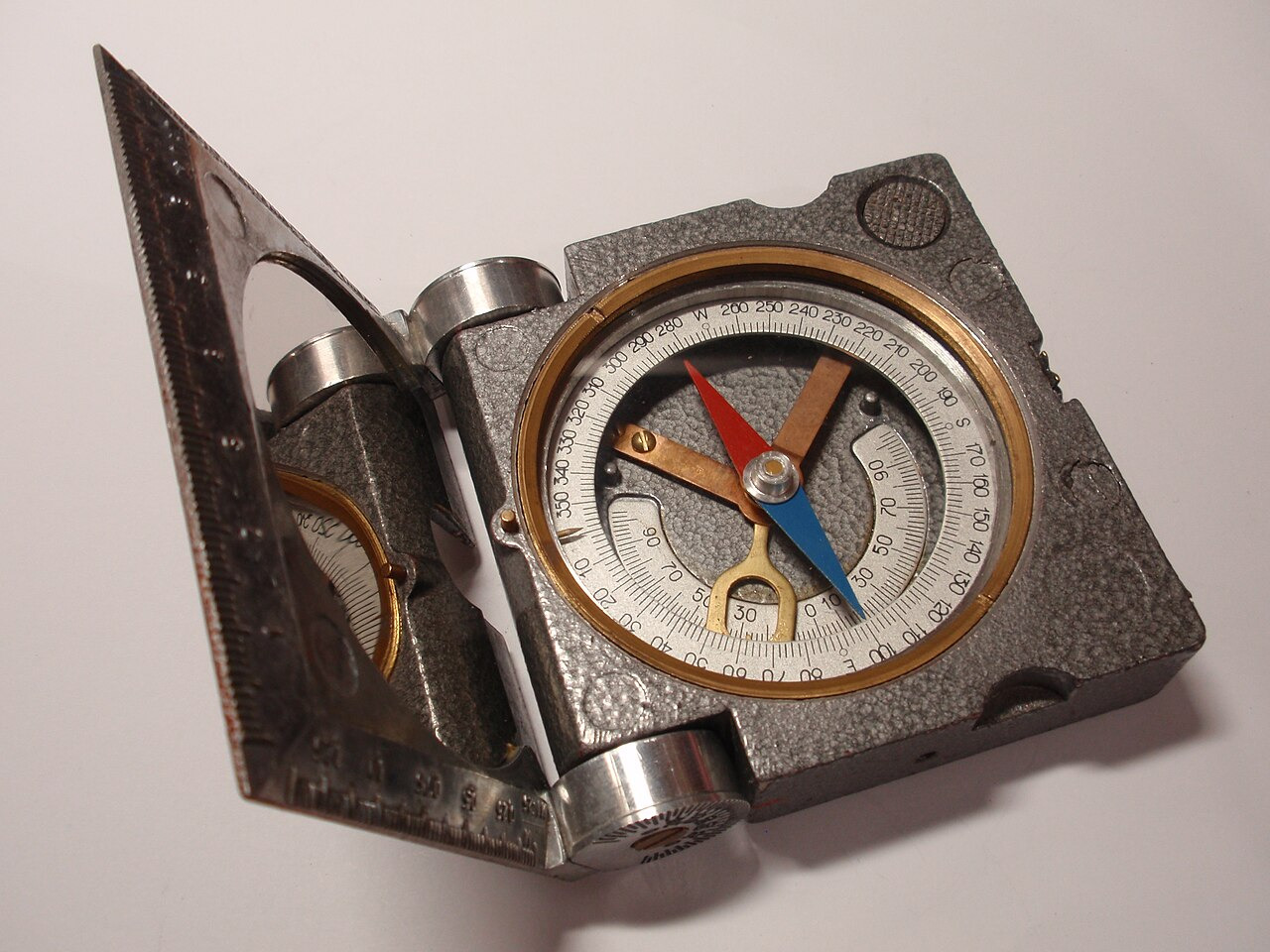
Such models are used by geologists, speleologists, and researchers. Due to their complexity and high measurement precision, they are more expensive and rarely used in everyday tourism.
Electronic compass
An electronic compass works using a magnetometer — a digital sensor that determines direction relative to Earth’s magnetic field. It is most often built into smartphones, smartwatches, and GPS devices, combining traditional navigation with modern technology.
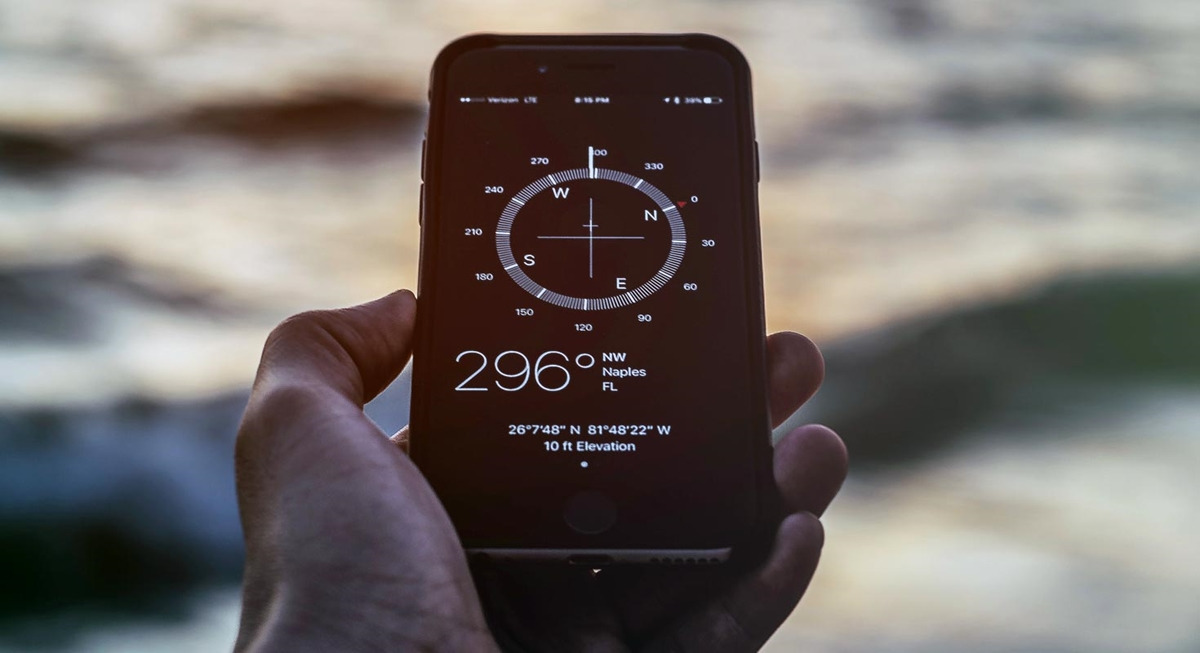
Its main advantage is convenience and additional features such as maps, route tracking, and altimeters. However, it depends on battery life and may be inaccurate near electronics or metal objects, so it is not always suitable as the sole navigation tool in the field.
Below is a table that helps understand the variety and choose the best companion for your travels:
| Type | Structure | Purpose | Where used |
|---|---|---|---|
| Liquid-filled magnetic | Liquid-filled capsule stabilizing the needle | Basic navigation | Tourism, hiking, travel |
| Baseplate | Transparent base with rulers | Map work | Orienteering, trekking |
| Lensatic (military) | Metal body, sighting mechanism | Precise bearing determination | Military, survival, difficult routes |
| Geological (clinometer) | Additional angle measurement scales | Measuring angles and formations | Geology, speleology |
| Electronic | Digital sensors (magnetometer) | Navigation + extra functions | Smartphones, smartwatches |
In addition to these, there are also mechanical solar compasses (which determine direction using shadows), as well as aviation models with correction for aircraft tilt. For an average traveler, the best choice remains a liquid-filled or baseplate compass — simple, reliable, and requiring no special skills. The main rule is to keep any magnetic compass away from metal objects, power lines, and large iron masses, otherwise it will become inaccurate.
Interestingly, some types, such as geological compasses, can cost a fortune due to their high precision. However, for an ordinary traveler who loves mountains, a good liquid-filled compass costing around 500–1000 UAH is usually sufficient. The main thing is that it should be water-resistant and have clearly visible markings in low light.
How to use a compass
So, you find yourself in unfamiliar terrain, and your smartphone is dead. There is no need to panic if you have this simple mechanical assistant in your pocket. Before heading into the mountains, learn a few basic steps. In fact, even a teenager can master it in five minutes. The key is to remember the sequence and avoid common mistakes.
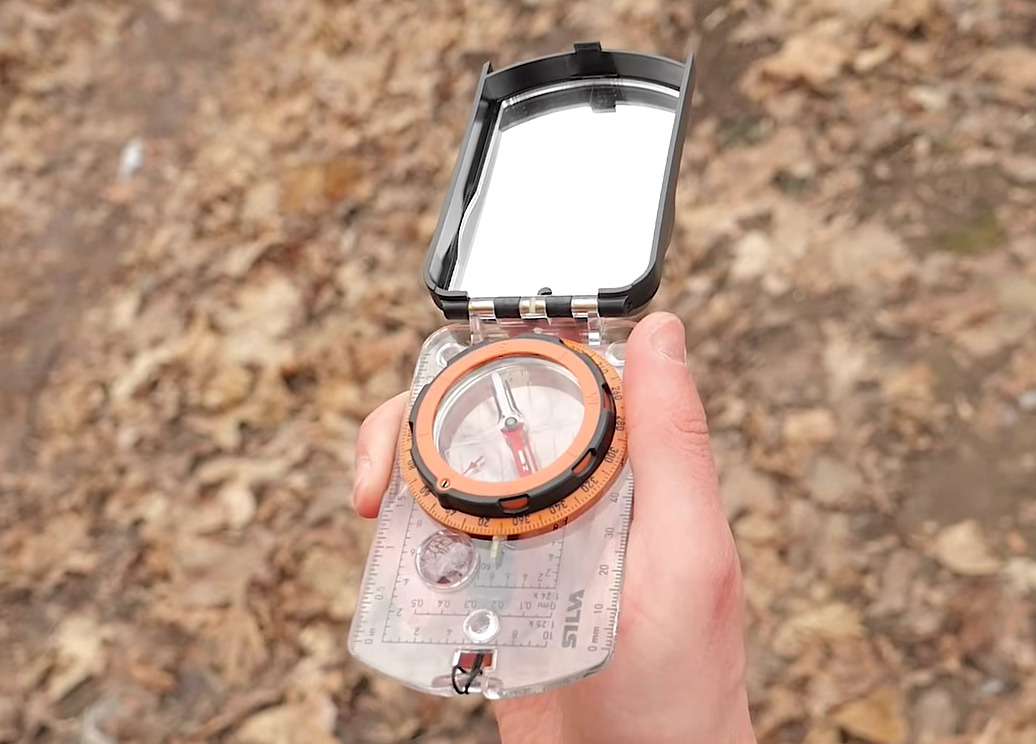
Before use, check that the device is working properly. Place the compass on a horizontal surface and wait for the needle to settle. It should move freely and quickly return to its position after a slight rotation. This means the mechanism is functioning correctly.
- Determining directions: Hold the compass horizontally in your hand. Turn yourself until the north end of the needle aligns with the “N” or “0°” mark. Now you can clearly see where north, south, east, and west are.
- Taking a bearing: Point the compass at a chosen landmark (for example, a peak or a tree). Then rotate the bezel until the orienting arrow aligns with the magnetic needle. The value on the scale shows your bearing in degrees.
- Moving along a bearing: Hold the compass in front of you and move so that the magnetic needle stays inside the orienting arrow (“the house”). The direction of movement is set by the line on the compass housing.
If an obstacle appears along the way, it is important to bypass it correctly. For example, take 30 steps at a right angle away from your route, go around the obstacle, then take 30 steps in the opposite direction to return to your original line of travel. This helps you stay on course.
Map work deserves special mention. Place the map on a flat surface and put the compass on top so that its side edge aligns with the north–south line on the map. Then rotate the map together with the compass until the needle points north. Voilà — your map is now oriented to the terrain! You can easily determine which mountain is to your left and which is ahead.
Practice these skills at home, in a park, or at a cottage. Because when a real mountain trip surprises you with fog or heavy rain, your actions must be automatic. Then no weather will knock you off the right path.
Mountain hiking with ExtremeGuide
 Himalayas
Dates:
October 10 – October 27
Complexity:
Duration:
Height:

Left: 12 places
 Lycian Trail
Dates:
October 25 – November 3
Complexity:
Duration:

4.9 (27)
Left: 12 places
 Lycian Trail
Dates:
October 17 – October 24
Complexity:
Duration:
4.9 (27)
Left: 9 places
 Argentina
Dates:
February 21 – March 9
February 21 – March 13
Complexity:
Duration:
Height:
4.9 (27)
Left: 12 places
 Nepal (Himalayas)
Dates:
November 7 – November 22
Complexity:
Duration:
Height:
Left: 12 places
 Nepal (Himalayas)
Dates:
March 28 – April 10
March 28 – April 13
Complexity:
Duration:
Height:

5.0 (90)
Left: 12 places
 Africa
Dates:
October 24 – November 4
Complexity:
Duration:
Height:
Left: 8 places
 Africa
Dates:
October 10 – October 18
December 25 – January 2
January 3 – January 11
January 31 – February 8
February 28 – March 8
Complexity:
Duration:
Height:

5.0 (1)
Left: 8 places
 Africa
Dates:
December 25 – January 4
February 28 – March 10
Complexity:
Duration:
Height:
4.9 (27)
Left: 8 places
 Africa
Dates:
October 10 – October 22
December 25 – January 6
January 3 – January 15
January 31 – February 12
February 28 – March 12
Complexity:
Duration:
Height:
5.0 (1)
Left: 8 places
 Pamir
PamirDates:
Complexity:
Duration:
Height:
 Carpathians
Dates:
Complexity:
Duration:
Height: